

Why Aevah

Buy measurable operating performance. Not the assembly project.

Aevah is the Enterprise Intelligence OS: one governed operating platform for data management, data science, AI, machine learning, applications, workflows, and evidence—so the enterprise can improve consequential outcomes without assembling the organization and toolchain behind them.

The capability you are buyingBuyer decision view
AevahA production decision capability
  1. 01Governed data
  2. 02Business meaning
  3. 03Models
  4. 04Applications
  5. 05Controls
  6. 06Evidence

OutcomeThe enterprise avoids assembling another fragmented team and toolchain

The boundary buyers need to see

Frontier intelligence can propose. Aevah makes the result repeatable and accountable.

Aevah does not replace the reasoning power of frontier AI. It provides the governed data, tools, business meaning, logging, authority, and evidence required to use that power in consequential enterprise decisions.

Where frontier intelligence stopsOne governed path from probabilistic reasoning to repeatable enterprise action
Consequential requestWhat should the business do next?Named owner · approved scope · current context
Frontier AIExplore and propose
Access permitted dataReason across contextInfer and extrapolatePropose a conclusion

Powerful, probabilistic intelligence

Aevah boundaryGround
Govern
Repeat
ContextPolicyAuthorityEvidence
Unsupported output never silently becomes consequential action.
AevahOperationalize and prove
Governed data and toolsBusiness meaning and policyLogged inputs and versionsAuthority and evidence

Repeatable, explainable enterprise capability

Model outputGoverned decisionAccountable actionInspectable evidence

The enterprise choice

Most alternatives provide an ingredient. Aevah provides the operating capability.

The issue is not whether the alternatives are powerful. It is how much work remains before the enterprise can repeatedly produce, govern, operate, and improve measurable outcomes.

AlternativeWhat it providesWhat the enterprise still assemblesTypical boundary
Rely on frontier AI alonePowerful general reasoning and rapidly improving modelsGoverned business meaning, trusted tools, repeatability, authority, operating integration, and evidenceThe model can propose; the enterprise must still establish what may become action
Build the internal organizationSpecialized people, platforms, and infrastructureHiring, architecture, integration, standards, delivery, and retentionCapability follows the assembly project
Assemble data and AI platformsPowerful infrastructure and specialist environmentsSemantics, use-case delivery, applications, operations, and adoptionThe toolchain still has to become a business capability
Commission an isolated modelA defined analysis, model, or proof of conceptProductionization, controls, workflow, monitoring, and the next use caseValue is difficult to operate and compound
Purchase analytics aloneGoverned exploration, metrics, dashboards, and answersPredictive models, operational authority, action, writeback, and outcome learningInsight can remain separated from execution
AevahEnterprise Intelligence OSData, context, models, optimization, applications, agents, workflow, controls, and evidenceDefine the business problem, provide relevant access, and retain accountable authorityBegin with one operating outcome and reuse the accepted foundation

For the complete capability proposition, see Operational Data Science.

Enterprise work, described honestly

Outcomes moving from fragmented analysis toward production.

These anonymized patterns show the operating situation, accountable owner, relevant signals, and acceptance evidence. They do not turn work in progress into an outcome claim.

Production delivery selected

Growth under production constraint

A rapidly growing consumer-products manufacturer is introducing new products while operating near available production capacity. FP&A needs to understand demand early enough to guide adoption, margin, and production choices together.

Accountable ownerFP&A
Executive pathCFO
Relevant signals
  • Syndicated market data
  • ERP and sales
  • Product and customer
  • Promotion and inventory
  • Finance and planning workbooks
Acceptance evidence
  • Forecast performance
  • Causal promotion lift
  • Product adoption and margin response
  • Capacity returned to strategic analysis
Evidence boundary

The production scope and acceptance measures are established. Realized performance will be reported only after the agreed baseline and observation period are complete.
Decision scope

Commercial margin and promotion accountability

A commercial organization needs pricing, promotions, customer response, product mix, and margin economics to meet inside one accountable decision path instead of separate reports and models.

Accountable ownerRevenue-growth leadership
Executive pathCommercial executive
Relevant signals
  • Price and promotion history
  • POS and volume
  • Trade spend
  • Cost and contribution
  • Customer and product hierarchies
Acceptance evidence
  • Incremental margin
  • Causal lift
  • Cannibalization and halo
  • Decision-cycle time
Evidence boundary

This pattern describes an active decision scope, not a published customer outcome or universal commercial result.

Evaluation path

Sourcing cost and operating exposure

An enterprise sourcing function needs to connect suppliers, contracts, commodities, logistics, quality, continuity, and product economics before cost actions create downstream operating risk.

Accountable ownerSourcing leadership
Executive pathFinance and operations
Relevant signals
  • Supplier identity
  • Contracts and terms
  • Commodity and logistics signals
  • Quality and continuity
  • Product economics
Acceptance evidence
  • Addressable cost
  • Continuity exposure
  • Scenario confidence
  • Approved and observed action
Evidence boundary

This is an evaluation pattern. The specific decision, source access, analytical method, and acceptance measures must be agreed before delivery.

The Aevah evidence standard

Value is defined before the model is built.

Aevah does not manufacture an ROI number after delivery. The baseline, owner, measures, observation period, and evidence boundary are agreed before production work begins.

  1. 01 · Baseline

    Name the current operating burden

    Record how the decision is made today, how long it takes, where confidence breaks down, and which economic or operating measures already exist.

    Produces · Current-state evidence
  2. 02 · Acceptance

    Define value before building

    Agree the accountable owner, minimum useful data, action boundary, adoption signal, measurement horizon, and evidence required to continue.

    Produces · Acceptance contract
  3. 03 · Production

    Observe the decision in use

    Retain the model version, assumptions, confidence, recommendation, human challenge, approval, intervention, and exceptions inside the operating record.

    Produces · Decision evidence
  4. 04 · Outcome

    Report where the conclusion stops

    Compare observed performance with the accepted baseline, disclose constraints, and make an explicit accept, refine, pause, or expand decision.

    Produces · Executive evidence decision
Decision contractOwner · baseline · boundary · measure · evidence

Expansion is earned by accepted evidence, not assumed from activity, model accuracy, or a completed implementation.

The compounding advantage

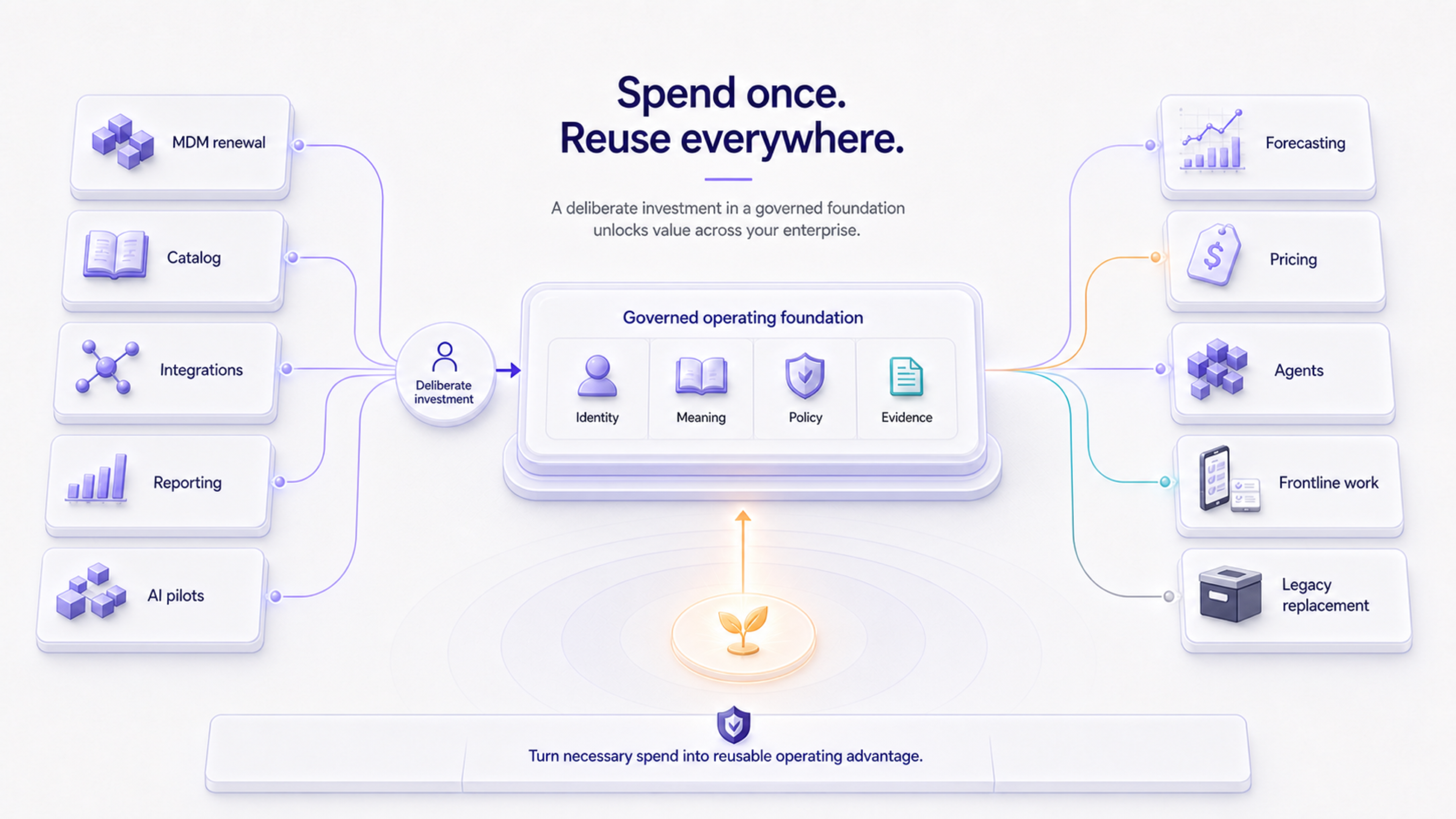
Establish the business context once. Reuse it across every next decision.

Accepted entities, definitions, permissions, analytical assets, workflow patterns, and evidence become reusable governed business context—not disposable project output.

A single governed Aevah foundation supporting pricing, forecasting, master data, agents, applications, and other enterprise capabilitiesOpen full resolution
Each additional capability remains independently scoped and governed while reusing accepted enterprise context.

A credible way to begin

Production first. Evidence before expansion.

First Flight is a bounded operating engagement—not an open-ended pilot. Agree on the outcome, owner, controls, and evidence before delivery begins.

Best fitUrgent outcome+Named owner+Executive sponsor
  1. 01

    Value framing

    Name the outcome, accountable owner, baseline, value levers, boundaries, and evidence required.

    ProducesValue Brief
  2. 02

    Stage the prerequisites

    Confirm source access, customer owners, operating constraints, security, and acceptance measures.

    ProducesAgreed readiness plan
  3. 03

    First Flight

    Put one bounded capability into production. Pre-packaged use cases target 30 days after prerequisites are staged; custom scopes use an agreed plan.

    ProducesProduction capability
  4. 04

    90-day evidence decision

    Measure adoption and operating progress, then explicitly accept, refine, pause, or expand.

    ProducesExecutive evidence decision
Executive outcomeAccept · refine · pause · expand

A practical next step

Start with the outcome your enterprise needs to improve.

We will map the relevant systems, business context, analytical intelligence, authority, workflow, evidence, and fastest credible production path.

Build your Value Brief