

Continuity
Give designated critical workflows a customer-controlled operating path when an external provider is unavailable.
Sovereign AI
Aevah gives your enterprise customer-controlled AI capacity for critical and predictable workloads, with governed access to frontier models when their specialized capability creates value.
Aevah Sovereign AI is the deployment and continuity layer of Aevah's operational data science platform: customer-controlled compute, models, governed data, tools, policies, and evidence for operating selected AI-dependent workflows independently.
Customer-controlled · Model-independent · Cloud-connected · Auditable
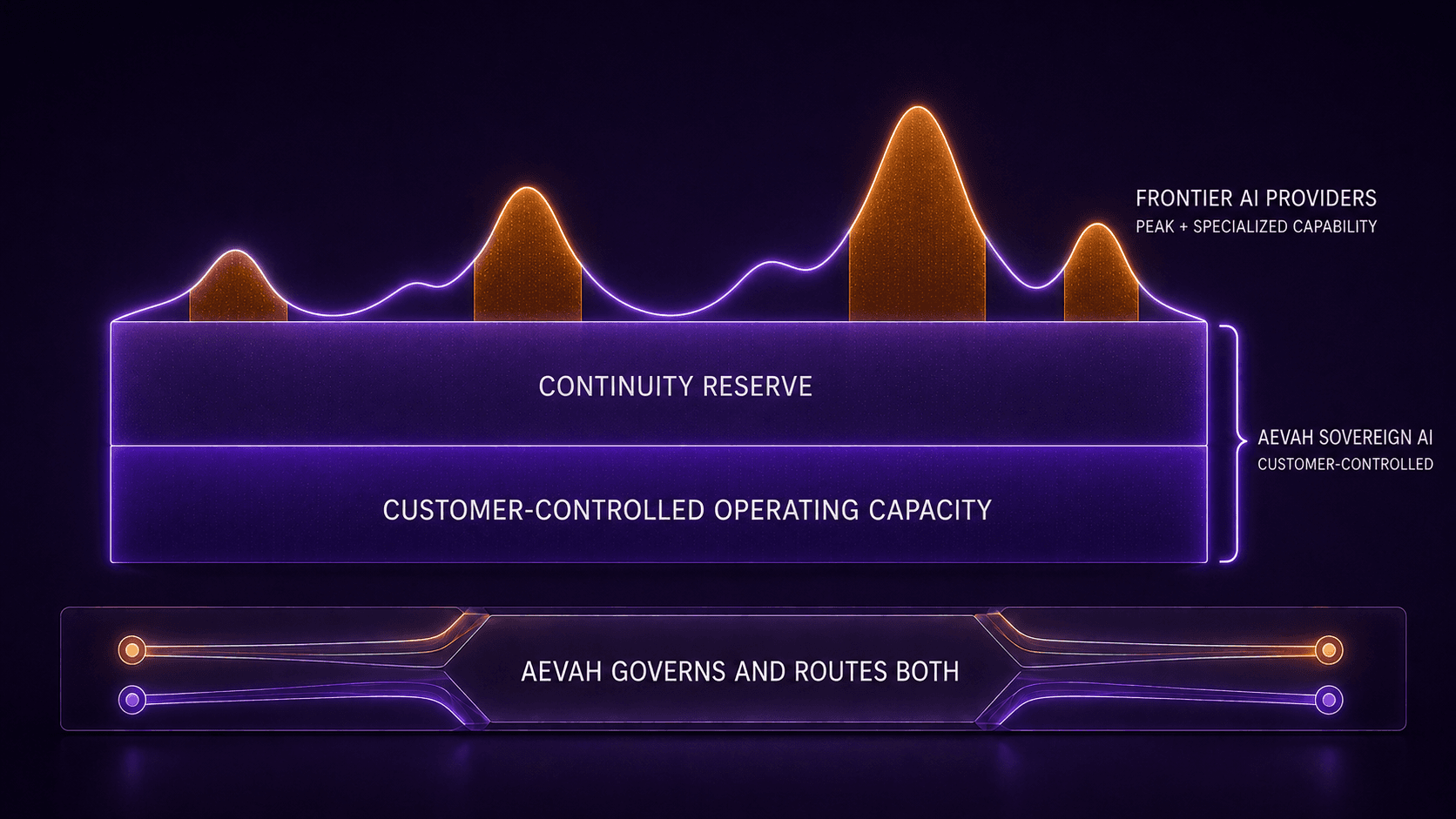
Aevah governs and routes both.
AI becomes critical infrastructure
As AI moves into customer experiences, planning, pricing, service, operations, and decision-making, provider availability and variable consumption become operating concerns—not merely technology concerns. Sovereign AI establishes a dependable customer-controlled base without giving up frontier capability.
Give designated critical workflows a customer-controlled operating path when an external provider is unavailable.
Match model capability and consumption economics to the work instead of sending every task to the largest model.
Keep sensitive data, permissions, actions, and evidence inside explicit enterprise boundaries.
For the CFO
Aevah frames the decision around total operating demand, required resilience, and the appropriate mix of controlled and variable capacity. The result is a customer-specific comparison, not a universal savings claim.
Controlled capacity + frontier consumption + operations and support + resilience exposure
The Aevah evaluation path
It belongs after the business has identified which AI-dependent workflows are critical, what degraded operation is acceptable, and where customer-controlled capacity changes risk or economics.
Begin with a measurable business result and the executive accountable for improving it.
Continue →Name the consequence, current burden, baseline, intervention, and measures that matter.
Continue →Trace the data, meaning, models, application, workflow, and learning required in production.
Continue →Evaluate authority, security, deployment, implementation boundaries, and acceptance evidence.
You are hereLeave with a useful outcome and value hypothesis before deciding whether a working session is warranted.
Continue →Governed workload routing
Aevah evaluates each workload against the operating requirements the enterprise defines. Routine work can remain on customer-controlled capacity. Specialized reasoning can be routed to a frontier provider. Authority and evidence remain attached across both.
Frontier models can reason. Aevah determines where, when, and under what authority they participate in business operations.
Operational continuity
When an external model is unavailable, Aevah can route qualified workloads to customer-controlled capacity, maintain explicit operating boundaries, and preserve the evidence needed to reconcile activity after service is restored.
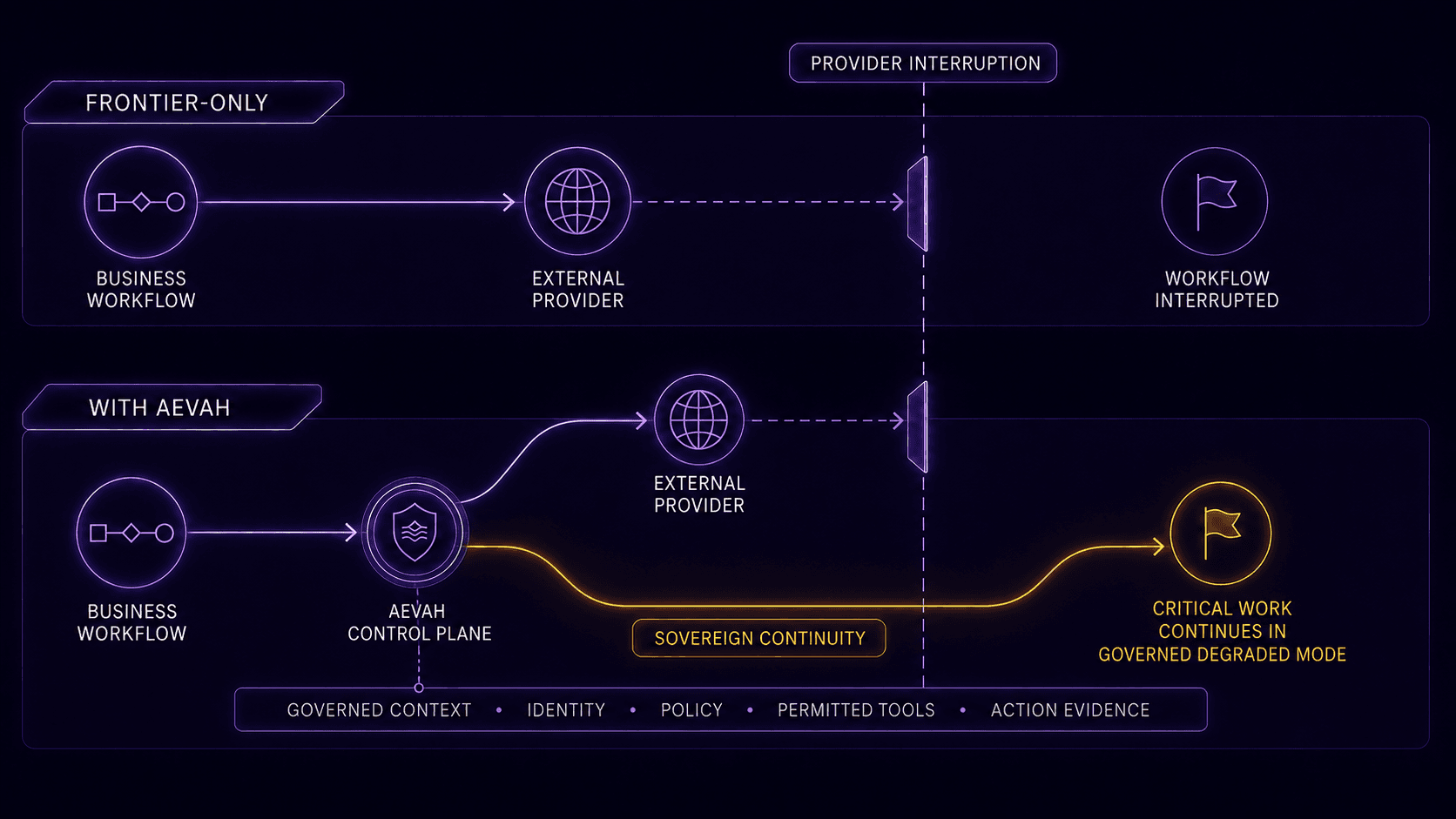
Continuity must be engineered and tested. It depends on compatible models, synchronized data and tools, sufficient controlled capacity, explicit routing, and an agreed degraded operating mode.
Proof before the claim
Retail and CPG examples
Routing is established for the customer’s models, data, controls, performance requirements, and operating environment. The goal is not to force every workload into one location; it is to make the choice explicit.
Approved retrieval, search, and routine responses
Unusual conversational reasoning
Continue approved answers and tools; escalate unsupported questions
Forecasts, rules, constraints, and prioritized exceptions
Novel scenario exploration
Continue ranking exceptions from accepted forecasts, inventory, and constraints
Causal models and accepted commercial context
Complex narrative investigation
Continue accepted causal analysis; defer unsupported narrative investigation
Elasticity, cost, demand, and constraint analysis
Specialized external research
Preserve governed recommendations; pause unavailable external research
Approved answers and governed enterprise tools
Exceptional or ambiguous situations
Continue bounded service; route exceptions to accountable people
A practical adoption path
Sovereign AI can begin with continuity for a bounded set of critical workflows, then expand as the enterprise learns where controlled capacity produces the greatest operating return.
Identify the AI-dependent workflows that cannot stop, establish a customer-controlled path, and prove it through an induced provider interruption.
01Move suitable recurring workloads onto sovereign capacity to improve control, availability, and workload economics.
02Route work across sovereign and frontier resources according to policy, availability, performance, cost, and required capability.
03More than hardware
Hardware is necessary. It is not sufficient. Aevah connects customer-controlled capacity to models, governed business context, permissions, workflows, monitoring, and evidence so it can support consequential operations.
Aevah Sovereign AI establishes the customer-controlled operating base. Frontier models remain available for peak demand, unusual complexity, and specialized capability. Aevah governs the boundary between them.
Control has a physical form
“Customer-controlled” can mean different things. The topology and responsibility model are agreed for each customer rather than hidden inside one mandatory delivery pattern.
Dedicated capacity inside the customer’s physical and network boundary.
Explore Sovereign Rack →02A discrete deployment with operating responsibilities agreed for the customer.
Explore Private Infrastructure →03Sovereign operating controls aligned to the customer’s approved cloud environment.
Review architecture →Responsibility must be explicit
Final accountability, service levels, supported models, recovery objectives, and access boundaries are confirmed during architecture and security review.
Ownership, location, utilization, and expansion threshold
Approved models, compatibility, terms, and replacement path
Authority, secrets, access, egress, and confirmation boundaries
Health, failover trigger, degraded mode, recovery, and escalation
Maintenance windows, approved access, evidence, and accountability
Evidence before scale
A Fortune 100 continuity claim should be inspectable. Aevah frames the first scope around observable behavior, explicit boundaries, and evidence the buying committee can use to accept, refine, or stop.
The selected workflow continues through an induced provider interruption.
Permitted degraded behavior and accountable escalation are documented.
Restricted data does not cross prohibited boundaries.
Routing decisions, model versions, and source context are recorded.
Identity, authorization, and confirmation remain enforced.
Performance meets the agreed operating requirement.
Recovery and return to normal routing are tested.
Workload economics are compared with the accepted baseline.
Exact recovery objectives, supported models, throughput, topology, and assurance evidence are customer-specific and become contractual only through the applicable agreement.
For the buying committee
A useful first step
Use these questions to identify the first credible continuity boundary before choosing infrastructure, models, or providers.
Which AI-dependent workflows would materially affect customers, revenue, operations, or risk if unavailable?
How long can each workflow tolerate an interruption?
Which data and actions must remain inside customer-controlled infrastructure?
Which tasks require frontier capability—and which do not?
What minimum operating capacity must remain available independently?