

Systems and context
Identify systems of record, relevant data and events, business definitions, owners, and refresh expectations.
Define boundaries and prerequisites around the customer’s systems, business context, identity, deployment, operations, and recovery.
Architecture evaluation begins with a bounded operating area and the responsibilities it creates. Detailed design follows the sources, environment, controls, and acceptance evidence agreed for that scope.
Where Aevah fits
Aevah works above existing systems of record, warehouses, lakehouses, files, streams, and model providers. It connects them to governed decision applications, people, agents, workflows, and operational action.
Architecture in one view
See how enterprise systems, sovereign deployment, customer-owned governed business context, people, applications, models, and agents connect through one governed action path.
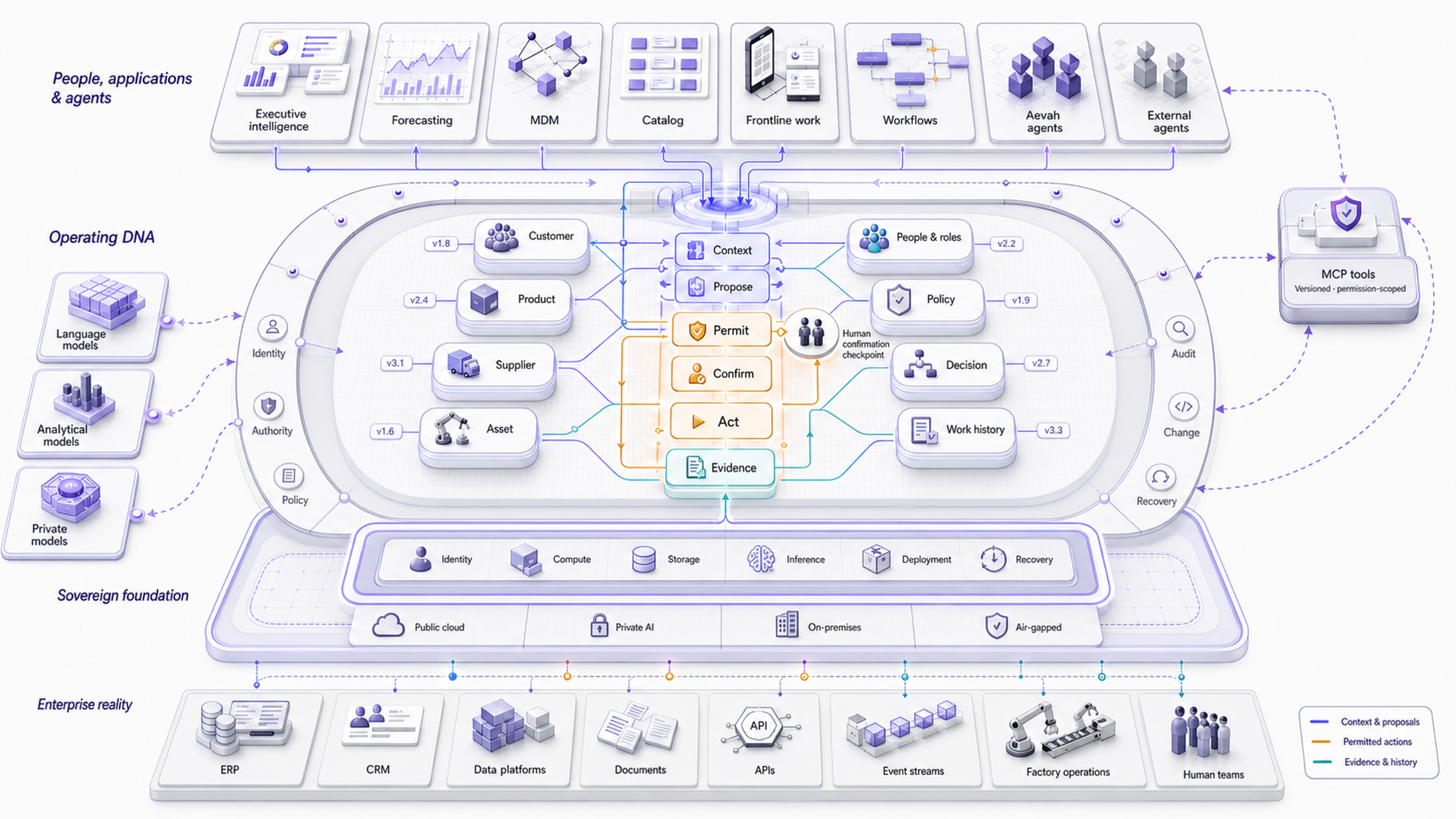
The Aevah evaluation path
The estate, data, models, applications, controls, and deployment boundary are only meaningful when the accountable outcome and evidence required for acceptance are explicit.
Begin with a measurable business result and the executive accountable for improving it.
Continue →Name the consequence, current burden, baseline, intervention, and measures that matter.
Continue →Trace the data, meaning, models, application, workflow, and learning required in production.
Continue →Evaluate authority, security, deployment, implementation boundaries, and acceptance evidence.
You are hereLeave with a useful outcome and value hypothesis before deciding whether a working session is warranted.
Continue →Identify systems of record, relevant data and events, business definitions, owners, and refresh expectations.
Use any language or analytical model and inference provider. Aevah routes work and automatically preserves Operating DNA, policy, workflow state, and evidence when the selected model changes.
Run the complete offering with customer-selected subscriptions, customer-controlled cloud inference, Aevah-managed private AI, Aevah datacenter, customer datacenter, or universal air-gapped operation.
Document the selected use case, source and environment readiness, integration work, identity and policy dependencies, customer responsibilities, Success Capacity, and what is excluded from the first scope.
Map human and service identities, least-privilege authorization, privileged access lifecycle, permitted sources, inference context, data movement, and review. The constraint layer is evaluated before an action is taken, not audited after it.
Contract-backed commitments cover the agreed performance, scale, recovery, and implementation targets. Complete rebuild, model replacement, operational handoff, and customer-run readiness preserve the customer’s Operating DNA.
Independently validated security enforcement and regulatory certifications extend across identity, isolation, policy, source, inference, action, and deployment boundaries.
Record what the customer owns, what Aevah drives, what is shared, and what remains excluded across infrastructure, inference, data, identity, operations, support, and acceptance.
Use customer-selected services inside an agreed operating boundary.
Keep inference accounts, access, and policy under customer control.
Use a privately operated footprint with responsibilities defined for the scope.
Place the agreed footprint in an Aevah-controlled facility.
Own the complete data, Aevah platform, AI, and inference environment for production operation in your datacenter, including air-gapped environments.
Every option carries the same Aevah operating layer. Environment prerequisites and operating responsibilities are confirmed for the selected scope.
Customer owns
Shared
Aevah drives
A practical next step
Create a preliminary Value Brief with the outcome, owner, current burden, value levers, signals, measures, constraints, and bounded starting point—before deciding whether a conversation is worthwhile.
Build the evaluation path