

Customer & Customer 360
Identity, household or account relationships, golden views, survivorship, stewardship, and governed downstream use.
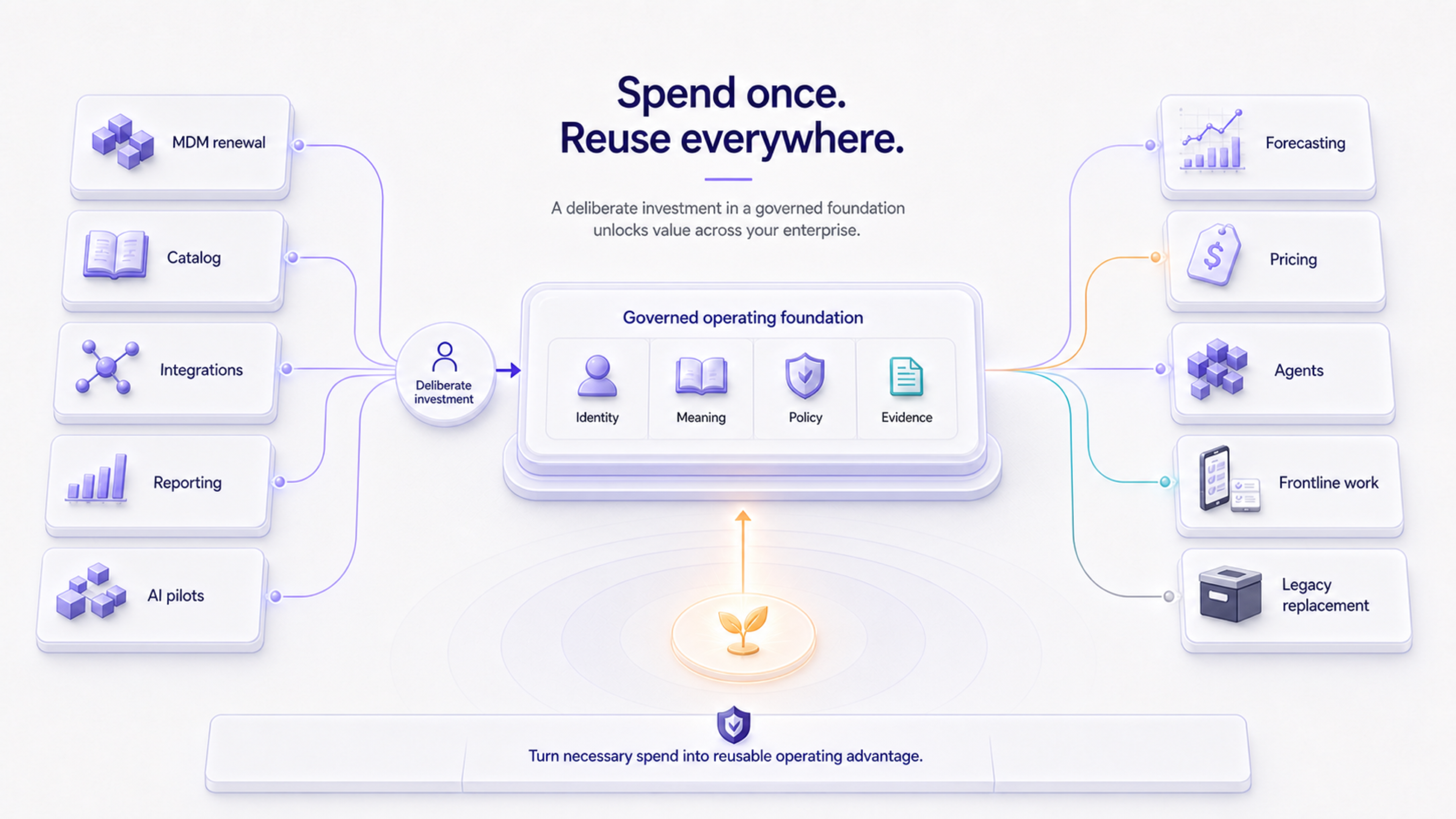
Preserve the MDM, Customer 360, product, party, supplier, asset, catalog, quality, data-science, and model-lifecycle capabilities the business depends on, then reuse one governed foundation across decisions, AI, workflows, and operating change.
The convergence moment
A renewal, end-of-life event, stalled modernization, or consulting-heavy operating model creates a convergence moment. The enterprise still needs trusted business identity, metadata, quality, analytical development, model validation, monitoring, and operating evidence. It no longer needs to fund those obligations as disconnected destinations.
Instead of recreating another isolated data or analytical category, consolidate its required identity, metadata, quality, lineage, model-lifecycle, and control obligations into the same operational data science platform serving business decisions, workflows, applications, agents, and evidence.
Two valid ways in
Aevah can begin with an urgent business decision or a replacement event. In either case, accepted identity, catalog, quality, analytical, model-lifecycle, control, and evidence capabilities become reusable across the enterprise.
Deliver value against a named owner and observable measure.
Accept the identity, context, models, controls, and evidence created by the work.
Replace the incumbent obligation only after equivalence and operating continuity are demonstrated.
Aevah does not require rip and replace. It earns the right to replace.
The Aevah evaluation path
Preserve the incumbent obligation, prove equivalence and continuity, then reuse the accepted identity, meaning, quality, lineage, models, controls, and evidence across business decisions.
Begin with a measurable business result and the executive accountable for improving it.
Continue →Name the consequence, current burden, baseline, intervention, and measures that matter.
Continue →Trace the data, meaning, models, application, workflow, and learning required in production.
You are hereEvaluate authority, security, deployment, implementation boundaries, and acceptance evidence.
Continue →Leave with a useful outcome and value hypothesis before deciding whether a working session is warranted.
Continue →Turn replacement spend into operating leverage
The economic case begins with budget already under pressure: renewal, maintenance, configuration, modernization, catalog, integration, and consulting. The opportunity is to preserve the required capabilities while expanding what that investment can do.
Replacement scope
Aevah can begin with one domain, one capability, or a coordinated replacement scope. Each is qualified against current sources, consumers, rules, history, controls, models, service expectations, and migration constraints.
Identity, household or account relationships, golden views, survivorship, stewardship, and governed downstream use.
Product identity, attributes, hierarchies, assortments, classifications, revisions, and commercial context.
Explainable identity, roles, relationships, onboarding state, exceptions, ownership, and history.
Asset and location identity, hierarchies, relationships, operating context, status, and accountable ownership.
Code sets, taxonomies, mappings, effective dates, versions, approvals, and reusable business definitions.
Source registry, metadata, lineage, definitions, ownership, onboarding state, revisions, and permitted use.
Rules, profiling, exceptions, ownership, remediation, monitoring, lineage, and evidence of fitness for the decision.
Preparation, features, statistical and causal analysis, training, validation, model selection, back-testing, monitoring, and retraining.
The strategic difference
Replacement should carry forward the obligations that matter while changing the economic and operating role of the platform.
Records consolidated as a destination
Explainable identity and relationships reused in decisions and work
A separate inventory people must consult
Source, meaning, ownership, lineage, and use remain connected
Technical queues and specialized screens
Exceptions routed to accountable business and data owners
Rules and dashboards separated from the decisions that depend on them
Quality observations, ownership, exceptions, and remediation attached to business context and use
Notebooks, pipelines, registries, and monitoring assembled across specialist tools
Training, validation, selection, back-testing, monitoring, and evidence connected to the governed decision
Projects, configuration, and consultant tickets
Versioned operating change supported by existing staff and Success Capacity
Trusted records and compliance with the platform
Trusted context plus governed AI, faster decisions, repeatable work, and visible evidence
When this path belongs on the agenda
A renewal or upgrade asks the business to pay again for essentially the same operating obligation.
The MDM or catalog program requires specialized developers and consultants to sustain routine change.
Customer 360, product, supplier, asset, or reference-data initiatives remain incomplete or difficult to reuse.
A merger, divestiture, platform consolidation, or cloud program forces identity and hierarchy decisions back onto the roadmap.
AI programs need governed business meaning, lineage, authorization, and operating context that the current stack does not provide.
Data-science, quality, or MLOps tooling remains fragmented across notebooks, pipelines, monitoring products, and specialist teams without a repeatable path into business action.
A qualified replacement path
The work is sequenced around incumbent responsibilities and customer acceptance, not a generic rip-and-replace promise.
Use cases, sources, consumers, controls
Retain, improve, retire, prove
Identity, context, stewardship, use
Sequence, reconcile, cut over
Evidence, decommission, reuse
Name the domains, sources, consumers, controls, service expectations, customizations, and renewal constraints the replacement must carry.
Agree what must be retained, improved, retired, exported, or proven before the incumbent can leave.
Use a bounded domain or pre-packaged use case to validate identity, context, stewardship, evidence, and downstream use.
Sequence sources, consumers, controls, history, cutover, recovery, and ownership around the customer environment.
Decommission only against agreed evidence; then reuse the governed context for the next decision, workflow, or AI use case.
Evidence for acceptance
Boundaries that stay explicit
What the budget can buy next
Once identity, relationships, definitions, sources, and controls become reusable governed business context, the same foundation can support governed AI, decision intelligence, frontline work, executive briefs, and repeatable operating flows. Aevah calls this durable customer-owned layer Operating DNA.
A practical next step
We’ll inventory the incumbent obligations, identify one provable domain, compare the replacement boundary, and frame the broader operating value the same budget could unlock.
Assess a replacement window