

Build, operate, supervise, and version enterprise agents.
A governed home for agents—wherever they run.
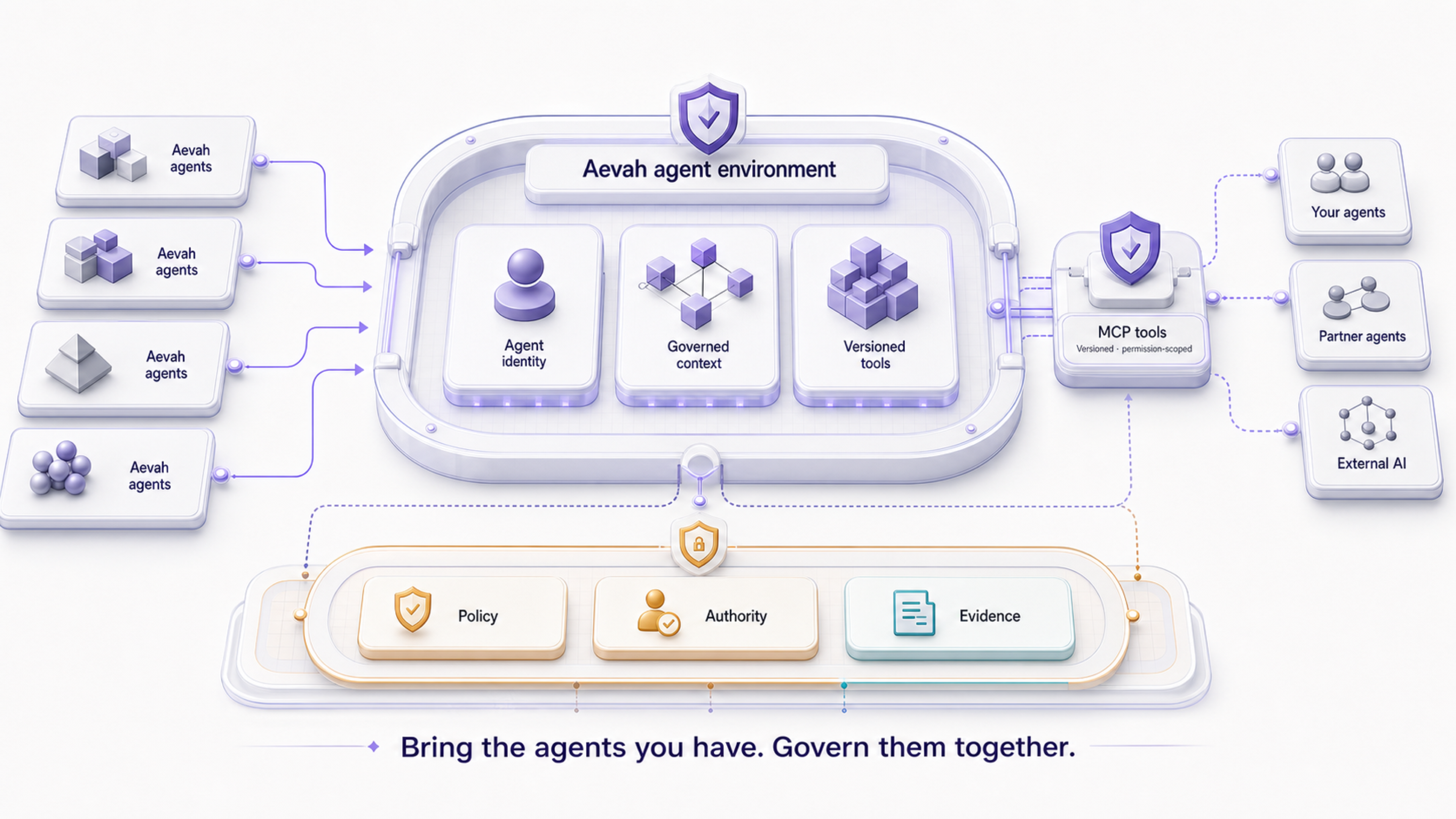
Build and operate agents inside Aevah—or let Claude, ChatGPT, and your existing enterprise agents call Aevah over MCP. Wherever an agent runs, it receives the same governed business context and never exceeds the initiating person's authority.
Claude, ChatGPT, and customer agents call Aevah over MCP.
Same identity. Same rules.
- 01Identity
- 02Permission
- 03Operating DNA
- 04Tool or action
- 05Versioned audit
An agent never receives more authority than the person who initiated it.
A home and a connection
Your agents can live here—or work with Aevah from anywhere.
Aevah gives enterprise agents a governed environment in which to operate, while also publishing versioned, schema-bound, permission-scoped tools that external agents can discover and call. Whether an agent lives in Aevah or reaches Aevah over MCP, it uses the same business meaning, permissions, classifications, version history, and audit rules. There is no privileged path.
Agents in Aevah
Build, operate, supervise, version, and audit enterprise agents inside a governed home connected to your Operating DNA.
Agents outside Aevah
Claude, ChatGPT, customer-built agents, and other enterprise agents can discover and call Aevah capabilities over MCP without moving into Aevah.
A home for every agent
Bring the agents you have. Govern them together.
Aevah agents operate inside the same governed environment that external, customer-built, and partner agents can use through versioned, permission-scoped MCP tools.
The Aevah evaluation path
Agents are an execution surface inside operational data science.
They do not create a separate product story. Agents use the same governed context, tools, authority, confirmation, evidence, and customer-controlled deployment as every other Aevah experience.
- 01Choose the outcome
Begin with a measurable business result and the executive accountable for improving it.
Continue → - 02Frame the value
Name the consequence, current burden, baseline, intervention, and measures that matter.
Continue → - 03Inspect the system
Trace the data, meaning, models, application, workflow, and learning required in production.
Continue → - 04Establish confidence
Evaluate authority, security, deployment, implementation boundaries, and acceptance evidence.
You are here - 05Build the Value Brief
Leave with a useful outcome and value hypothesis before deciding whether a working session is warranted.
Continue →
Agent-navigable website
Structured for agents browsing on your behalf.
The site itself is agent-navigable. Aevah's documentation and capability information are exposed as WebMCP tools, so an agent browsing on your behalf can search the documentation, retrieve capability and security detail, and prepare the essential inputs for a Value Brief — without scraping pages or guessing at structure. The Aevah application exposes the same kind of surface: an agent working alongside a person can search, inspect and propose, while anything consequential stays a human decision.
Review production developer capabilities →MCP Apps
Human decisions return a usable review surface.
When an agent reaches a decision only a person should make, Aevah hands back a usable interface rather than a wall of JSON. An agent proposing a merge returns a review surface showing the candidate records side by side, which attribute value wins and why, and approve or reject controls — rendered directly in the agent's own environment. The person decides on real evidence, in context, and the decision is captured in the audit trail. The interface is a rendering surface, never an authority: every approval is reauthorized against the approver's permissions before anything changes, and the surface never receives values the viewer is not cleared to see. Review surfaces cover merge and match review, survivorship explanation, data quality triage, mapping suggestion review, and generic proposal approval.
- 01Propose
- 02Review
- 03Approve
- 04Audit
Governed action
Three classes of tool.
Read
Returns data and changes nothing. Executes directly under the caller's permissions.
Propose
Produces a change proposal for a human to approve. Nothing changes until a person with the required authority approves it. Most agent-initiated change belongs here.
Execute
Performs a governed change under explicit prior confirmation, reauthorized at the moment it runs. Confirmation is single-use, bound to the specific operation, and cannot be reused or broadened.
An agent cannot promote itself between classes.
Tool families
The enterprise capability surface.
Catalog discovery
Returns the tools, versions, classifications, and permissions available to the caller.
Data navigation
Returns authorized entities, relationships, definitions, and business context.
Quality intelligence
Returns quality standards, failed checks, affected records, and supporting evidence.
Matching and survivorship insight
Returns candidate records, comparisons, proposed outcomes, and the evidence available for review.
Governance memory
Returns definitions, policies, ownership, decisions, approvals, and audit history.
Publication and activation
Returns publication status, eligible targets, activation outcomes, and correlation identifiers.
Operations
Returns operation status, progress, cancellation state, and per-record outcomes.
Identity and authority
Agents inherit your rules, not new ones.
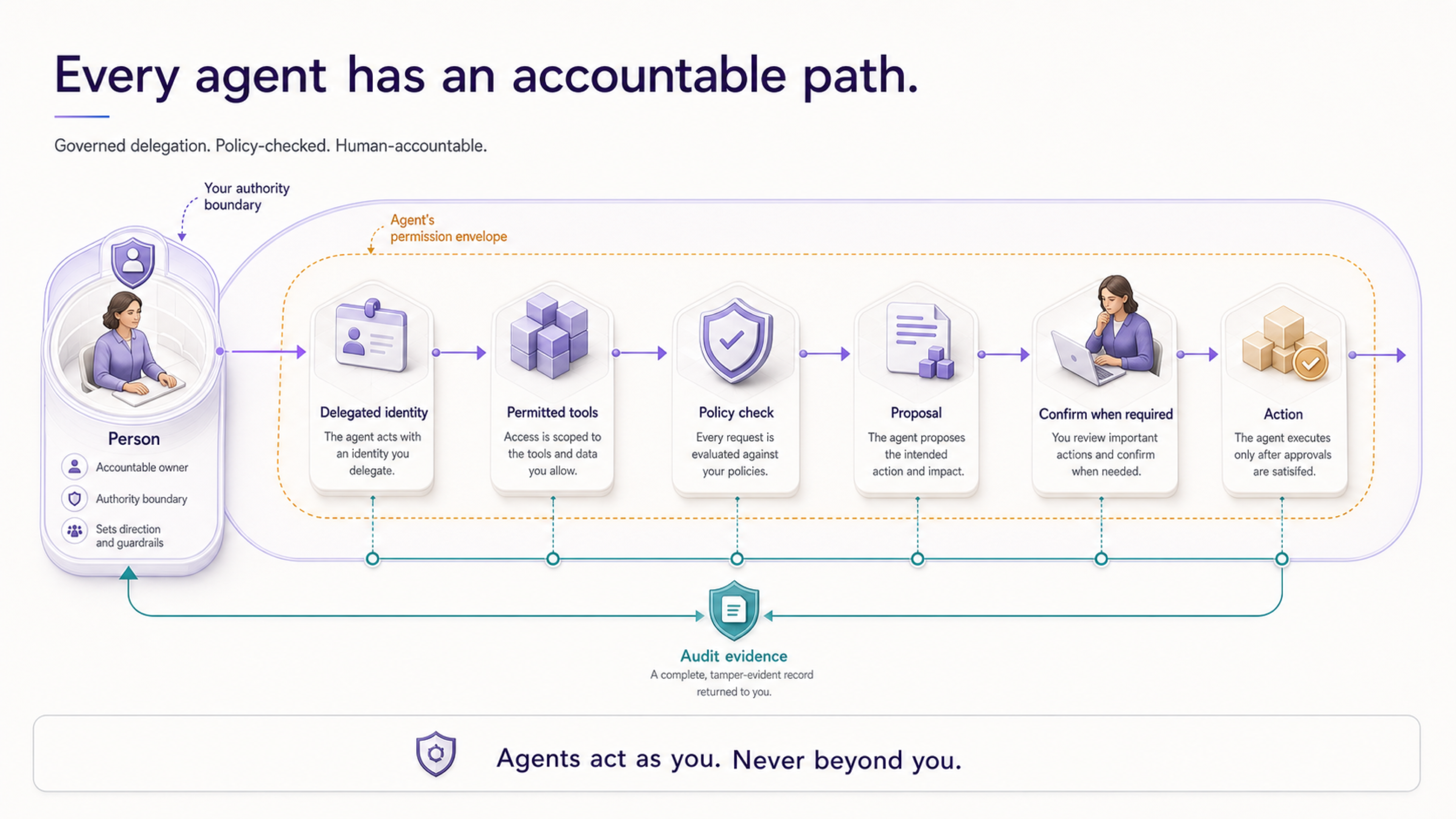
Every tool call carries the identity of whoever triggered it and can never exceed that identity's permissions. Sensitivity classification is honored on the way out, so a tool returns only what its caller is cleared to see. Actions that change data are recorded as new versions rather than overwrites, are safe to retry without duplicating work, and leave a complete audit trail — who acted, which tool, which version, what happened.
Review identity, authorization, isolation, and audit →Stable contracts
Contracts don't move underneath you.
Tools are versioned. A breaking change publishes a new version; the existing one is never altered. Agents built against a supported version keep working exactly as before, and deprecation is signalled in advance with a replacement pointer.
Delegated authority
Every agent has an accountable path.
The agent receives the triggering person’s identity and a bounded tool set, passes execution-time policy checks, proposes the intended action, and stops for human confirmation where the work requires it.
A governed change, end to end
A governed change follows one visible path.
- 01Agent proposes
- 02Steward reviews in Aevah
- 03Approved and executed under confirmation
- 04New version and audit record
This arc is the same whether the change originates with a person or an agent.
Complete history
Nothing is ever overwritten.
Governed changes are immutable and cumulative. Every change creates a new version; prior versions stay retrievable and comparable. Reverting moves forward — a prior version is reinstated by superseding the current one, so the record of what changed and what was undone survives intact. There is no destructive rollback, by design.
A practical next step
Request the security and integration detail pack.
First define the business decision, agent role, permitted context and tools, authority, human confirmation, evidence, deployment boundary, and acceptance criteria. We will map the relevant diligence detail to that evaluation.
Define your evaluation