

- POS and ecommerce
- Store and DC inventory
- Promotions and loyalty
- Product and assortment
- Supplier lead times
Protect margin without sacrificing profitable demand.
Pricing owners receive ranked actions with expected margin and volume response, visible assumptions, confidence, approval, and evidence attached. Connect store, digital, product, promotion, inventory, supplier, and customer signals to the merchandising and replenishment decisions that protect growth and availability.
The operating experience
See how the outcome changes—not another analytics project.
The business user receives a ranked, explainable operating view. Data preparation, model selection, back-testing, governance, monitoring, and evidence remain underneath it.
Aevah Data SciencePricing optimization
Illustrative interface · Retail & GroceryConsequential question
Owner review requiredWhich products can we reprice without losing volume?
Priority scopeWhat changedProposed actionState
01Core portfolio · Customer group A
Margin compression exceeds the accepted corridor
Review bounded price changeEvidence ready02Premium portfolio · Regional channel
Modeled sensitivity differs from the portfolio
Test the response scenarioReview required03Seasonal line · Promotion window
Cannibalization changes expected response
Hold and revise assumptionsMonitorAnalytical drivers · relative influence
Price elasticity
Cannibalization
Causal lift
Scenario optimization
Aevah recommendation
Prioritize the price corridors with defensible margin opportunity, then hold changes where volume response or customer terms remain unresolved.
Assumptions, confidence, and constraints attachedIllustrative operating experience—not a customer result. Actual signals, recommendations, acceptance measures, authority, and evidence are established for each bounded implementation.
Outcome to improve
Protect margin while maintaining volume, customer response, and commercial control.
- Accountable owner
- Commercial or finance executive
- Required participants
- Pricing · Sales · Finance · Category · Data
Applied to Retail & Grocery
The same decision system, grounded in this industry's operating reality.
Connect store, digital, product, promotion, inventory, supplier, and customer signals to the merchandising and replenishment decisions that protect growth and availability.
- On-shelf availability
- Sell-through
- Incremental margin
- Inventory turns
- Spoilage and markdown
Aevah combines these industry signals with the specific data, models, authority, action, and evidence required for pricing optimization.
Explore Retail & grocery →The Aevah evidence standard
Value is defined before the model is built.
Aevah does not manufacture an ROI number after delivery. The baseline, owner, measures, observation period, and evidence boundary are agreed before production work begins.
- 01 · Baseline
Name the current operating burden
Record how the decision is made today, how long it takes, where confidence breaks down, and which economic or operating measures already exist.
Produces · Current-state evidence - 02 · Acceptance
Define value before building
Agree the accountable owner, minimum useful data, action boundary, adoption signal, measurement horizon, and evidence required to continue.
Produces · Acceptance contract - 03 · Production
Observe the decision in use
Retain the model version, assumptions, confidence, recommendation, human challenge, approval, intervention, and exceptions inside the operating record.
Produces · Decision evidence - 04 · Outcome
Report where the conclusion stops
Compare observed performance with the accepted baseline, disclose constraints, and make an explicit accept, refine, pause, or expand decision.
Produces · Executive evidence decision
Decision contractOwner · baseline · boundary · measure · evidence
Compare recommendations with prior pricing decisions, observed volume and margin response, model back-tests, exceptions, approvals, and realized results.
Realized marginVolume responseAdoptionDecision cycle time
Operational data science behind this outcome
What Aevah assembles to produce measurable operating change.
Each capability below exists because a production outcome requires it. The business user experiences better performance—not the engineering, data-management, modeling, application, and governance handoffs behind it.
Connect and prepare
Bring in the relevant signals
- Transactions
- Price and cost
- Promotions
- Products
- Customers
- Competitive signals
Trust and understand
Establish governed business context
- Product and customer identity
- Commercial definitions
- Data-quality rules
- Elasticity features and models
- Decision history
Build and validate
Model and back-test the decision
- Price elasticity
- Cannibalization
- Causal lift
- Scenario optimization
- Back-testing
Decide and deliver
Put the answer into the work
A governed pricing workspace that ranks opportunities, explains the tradeoff, routes approval, and records the action and result.
Act and govern
Keep authority and traceability attached
- Commercial or finance executive
- Policy and permission
- Human confirmation and exception handling
- Compare recommendations with prior pricing decisions, observed volume and margin response, model back-tests, exceptions, approvals, and realized results.
Measure and learn
Know whether it worked
- Realized margin
- Volume response
- Adoption
- Decision cycle time
The platform return
Improve this outcome. Preserve the operational data science behind it.
The pricing optimization First Flight can establish reusable business context, quality rules, analytical assets, and evidence for the next business priority.
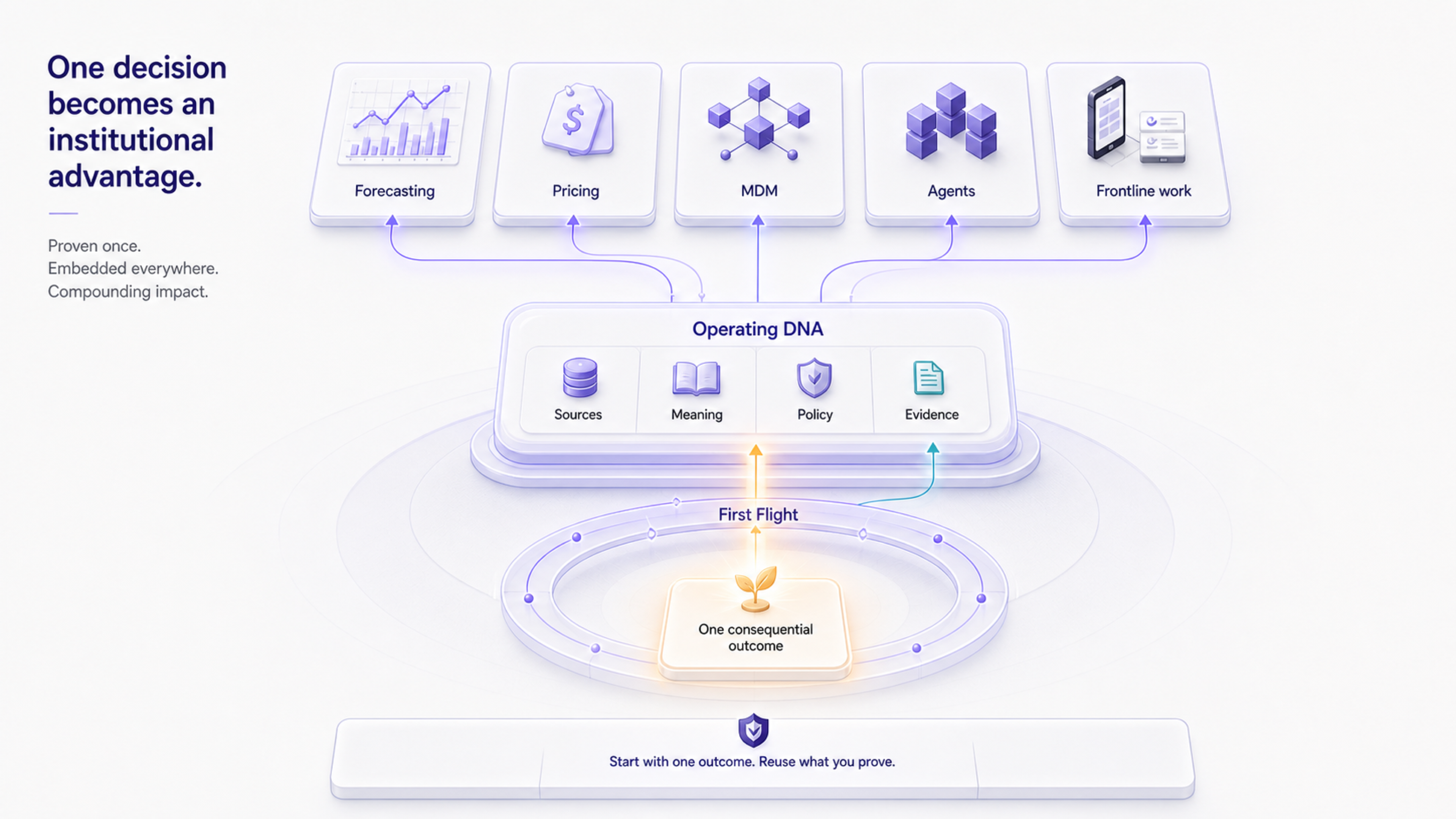
What this can build
- Product and customer identity
- Commercial definitions
- Data-quality rules
- Elasticity features and models
- Decision history
Implementation path
Qualify one bounded production outcome.
A bounded implementation around one consequential operating area. Pre-packaged use cases carry a 30-day target after agreed data, access, ownership, and environment prerequisites are staged.
The target is not a universal delivery guarantee. Custom use cases and unstaged prerequisites require a separately agreed plan.Prerequisites to stage
- Named decision owner
- Representative prior decisions
- Source and definition access
- Agreed action and approval boundary
Evidence to agree
Compare recommendations with prior pricing decisions, observed volume and margin response, model back-tests, exceptions, approvals, and realized results.
A practical next step
Build the value case for profitable margin in Retail & grocery.
Create a preliminary brief with the outcome, accountable owner, current burden, minimum useful data, analytical path, action boundary, measures, and bounded route into production.
Build this Value Brief