

Connect and prepare
Bring in the relevant signals
- Product and customer context
- Identity and permissions
- Policies and approved knowledge
- Inventory and availability
- Interaction history
- Action evidence
Teams use the right model for each task while Aevah governs the permitted data, tools, identity, policy, confirmation, action, and evidence around every production interaction.
The operating experience
The business user receives a ranked, explainable operating view. Data preparation, model selection, back-testing, governance, monitoring, and evidence remain underneath it.
Product and customer context
Advance for reviewEvidence readyIdentity and permissions
Test the scenarioReview requiredPolicies and approved knowledge
Retain and monitorMonitorA governed AI experience with explicit model boundaries, permitted tools and data, human authority, fallback behavior, monitoring, and evidence attached to every consequential action.
Assumptions, confidence, and constraints attachedIllustrative operating experience—not a customer result. Actual signals, recommendations, acceptance measures, authority, and evidence are established for each bounded implementation.
Outcome to improve
The Aevah evidence standard
Aevah does not manufacture an ROI number after delivery. The baseline, owner, measures, observation period, and evidence boundary are agreed before production work begins.
Record how the decision is made today, how long it takes, where confidence breaks down, and which economic or operating measures already exist.
Produces · Current-state evidenceAgree the accountable owner, minimum useful data, action boundary, adoption signal, measurement horizon, and evidence required to continue.
Produces · Acceptance contractRetain the model version, assumptions, confidence, recommendation, human challenge, approval, intervention, and exceptions inside the operating record.
Produces · Decision evidenceCompare observed performance with the accepted baseline, disclose constraints, and make an explicit accept, refine, pause, or expand decision.
Produces · Executive evidence decisionEvaluate the experience against an accepted task set and retain model, source, prompt, tool, policy, confirmation, exception, action, and outcome records within a bounded production scope.
Operational data science behind this outcome
Each capability below exists because a production outcome requires it. The business user experiences better performance—not the engineering, data-management, modeling, application, and governance handoffs behind it.
Connect and prepare
Trust and understand
Build and validate
Decide and deliver
A governed AI experience with explicit model boundaries, permitted tools and data, human authority, fallback behavior, monitoring, and evidence attached to every consequential action.
Act and govern
Measure and learn
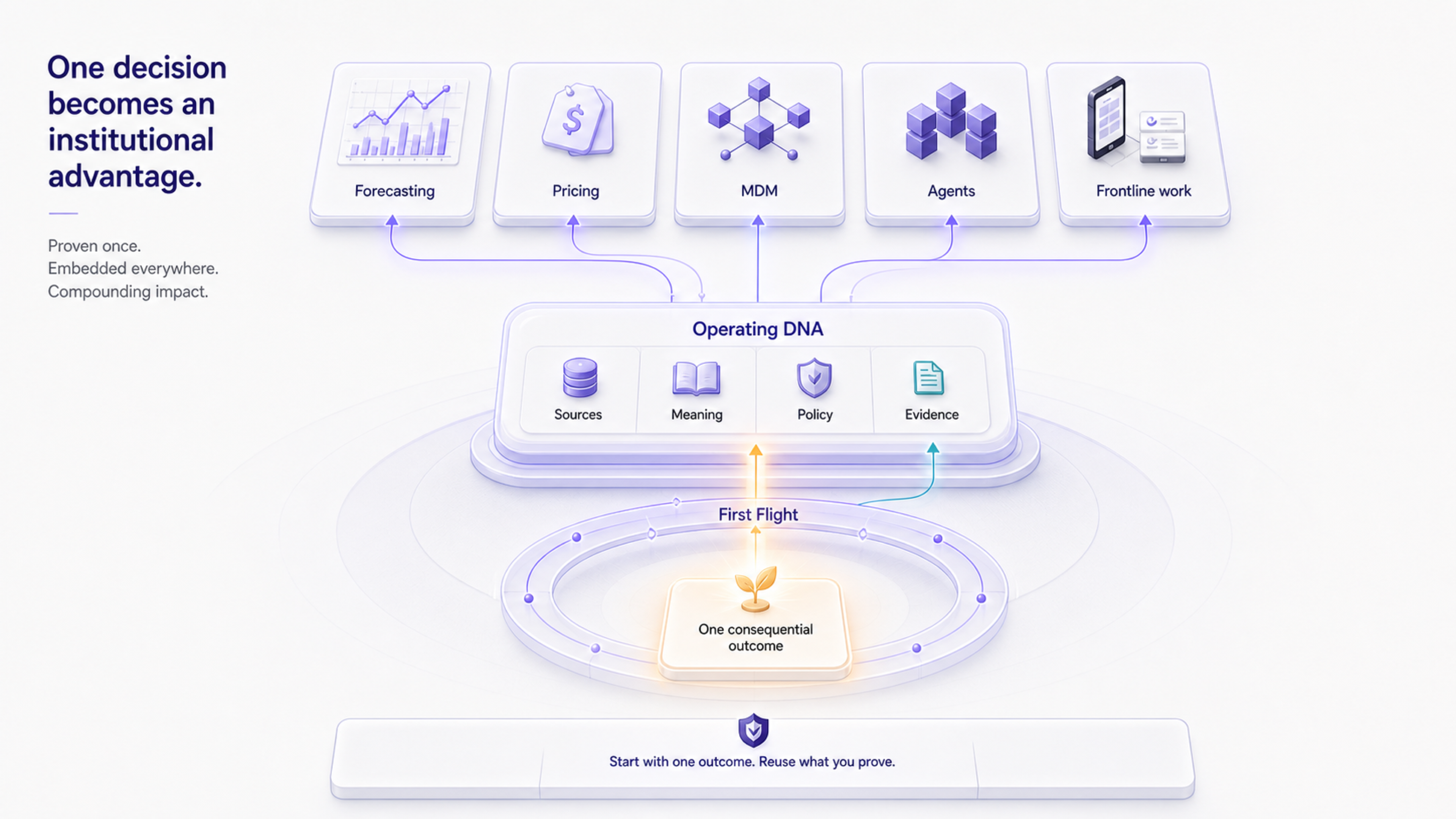
The platform return
The governed ai adoption First Flight can establish reusable business context, quality rules, analytical assets, and evidence for the next business priority.
What this can build
Implementation path
A bounded implementation around one consequential operating area. Pre-packaged use cases carry a 30-day target after agreed data, access, ownership, and environment prerequisites are staged.
The target is not a universal delivery guarantee. Custom use cases and unstaged prerequisites require a separately agreed plan.Prerequisites to stage
Evidence to agree
Evaluate the experience against an accepted task set and retain model, source, prompt, tool, policy, confirmation, exception, action, and outcome records within a bounded production scope.
A practical next step
Create a preliminary brief with the outcome, accountable owner, current burden, minimum useful data, analytical path, action boundary, measures, and bounded route into production.
Build this Value Brief