

- Asset telemetry
- Load and demand
- Weather and market
- Maintenance history
- Outage and operating plans
Improve forecast confidence before plans become commitments.
A continuously refreshed demand view connects forecast, causal drivers, uncertainty, constraints, scenarios, owners, and required intervention. Connect asset condition, load, market, weather, maintenance, workforce, and operating constraints to reliability and planning decisions.
The operating experience
See how the outcome changes—not another analytics project.
The business user receives a ranked, explainable operating view. Data preparation, model selection, back-testing, governance, monitoring, and evidence remain underneath it.
Aevah Data ScienceDemand planning and forecasting
Illustrative interface · EnergyConsequential question
Owner review requiredWhere will demand exceed or fall below plan—and what should we change now?
Priority scopeWhat changedProposed actionState
01Region East · Core portfolio
Demand outlook is above plan under constrained capacity
Reallocate available productionEvidence ready02Club channel · New-product launch
Adoption is ahead of the accepted analog curve
Raise near-term plan for reviewReview required03Region South · Seasonal portfolio
Event timing moved beyond the forecast assumption
Refresh causal scenarioMonitorAnalytical drivers · relative influence
Hierarchical forecasting
Demand sensing
Causal drivers
Scenario planning
Aevah recommendation
Reconcile the demand exceptions against capacity and commercial commitments, then route the selected plan changes to the owners who can intervene before the window closes.
Assumptions, confidence, and constraints attachedIllustrative operating experience—not a customer result. Actual signals, recommendations, acceptance measures, authority, and evidence are established for each bounded implementation.
Outcome to improve
Align growth, service, new-product adoption, inventory, and constrained production before the planning window closes.
- Accountable owner
- FP&A or planning executive
- Required participants
- FP&A · Demand planning · Commercial · Supply chain · Production
Applied to Energy
The same decision system, grounded in this industry's operating reality.
Connect asset condition, load, market, weather, maintenance, workforce, and operating constraints to reliability and planning decisions.
- Availability
- Avoided outage
- Forecast performance
- Operating cost
- Safety and compliance
Aevah combines these industry signals with the specific data, models, authority, action, and evidence required for demand planning and forecasting.
Explore Energy →The Aevah evidence standard
Value is defined before the model is built.
Aevah does not manufacture an ROI number after delivery. The baseline, owner, measures, observation period, and evidence boundary are agreed before production work begins.
- 01 · Baseline
Name the current operating burden
Record how the decision is made today, how long it takes, where confidence breaks down, and which economic or operating measures already exist.
Produces · Current-state evidence - 02 · Acceptance
Define value before building
Agree the accountable owner, minimum useful data, action boundary, adoption signal, measurement horizon, and evidence required to continue.
Produces · Acceptance contract - 03 · Production
Observe the decision in use
Retain the model version, assumptions, confidence, recommendation, human challenge, approval, intervention, and exceptions inside the operating record.
Produces · Decision evidence - 04 · Outcome
Report where the conclusion stops
Compare observed performance with the accepted baseline, disclose constraints, and make an explicit accept, refine, pause, or expand decision.
Produces · Executive evidence decision
Decision contractOwner · baseline · boundary · measure · evidence
Evaluate forecast performance by level and horizon, compare against accepted baselines, and retain overrides, drivers, scenarios, and resulting operating decisions.
Forecast performanceService levelBiasInventory exposurePlanner effort
Operational data science behind this outcome
What Aevah assembles to produce measurable operating change.
Each capability below exists because a production outcome requires it. The business user experiences better performance—not the engineering, data-management, modeling, application, and governance handoffs behind it.
Connect and prepare
Bring in the relevant signals
- Orders and shipments
- Syndicated demand
- Promotions
- Customer forecasts
- Inventory
- Capacity
Trust and understand
Establish governed business context
- Product-location hierarchies
- Demand features
- Calendar and event context
- Forecast versions
- Performance history
Build and validate
Model and back-test the decision
- Hierarchical forecasting
- Demand sensing
- Causal drivers
- Scenario planning
- Forecast reconciliation
Decide and deliver
Put the answer into the work
An explainable demand plan with exceptions, scenarios, capacity implications, accountable interventions, and forecast-performance evidence.
Act and govern
Keep authority and traceability attached
- FP&A or planning executive
- Policy and permission
- Human confirmation and exception handling
- Evaluate forecast performance by level and horizon, compare against accepted baselines, and retain overrides, drivers, scenarios, and resulting operating decisions.
Measure and learn
Know whether it worked
- Forecast performance
- Service level
- Bias
- Inventory exposure
- Planner effort
The platform return
Improve this outcome. Preserve the operational data science behind it.
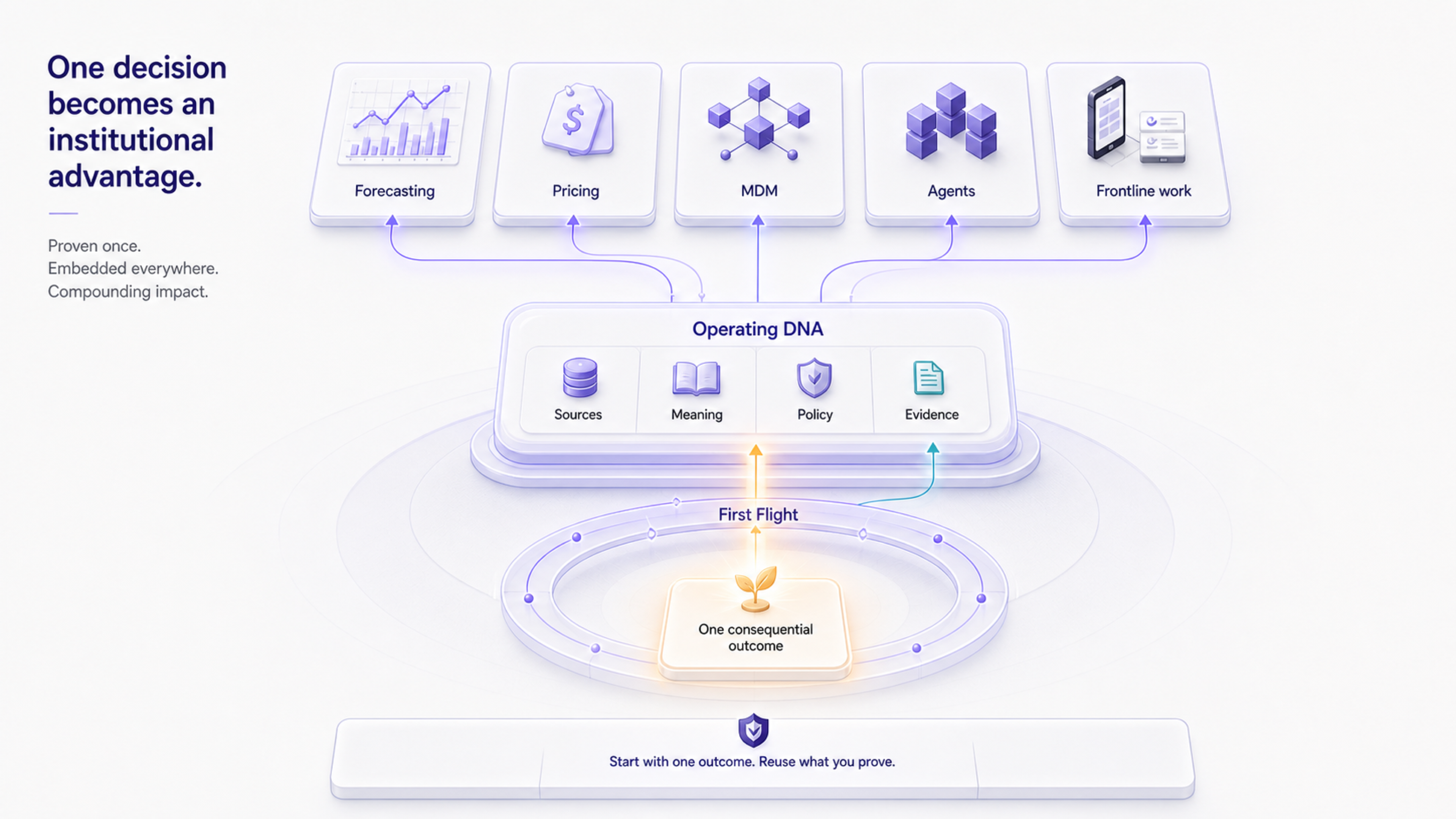
The demand planning and forecasting First Flight can establish reusable business context, quality rules, analytical assets, and evidence for the next business priority.
What this can build
- Product-location hierarchies
- Demand features
- Calendar and event context
- Forecast versions
- Performance history
Implementation path
Qualify one bounded production outcome.
A bounded implementation around one consequential operating area. Pre-packaged use cases carry a 30-day target after agreed data, access, ownership, and environment prerequisites are staged.
The target is not a universal delivery guarantee. Custom use cases and unstaged prerequisites require a separately agreed plan.Prerequisites to stage
- Named decision owner
- Representative prior decisions
- Source and definition access
- Agreed action and approval boundary
Evidence to agree
Evaluate forecast performance by level and horizon, compare against accepted baselines, and retain overrides, drivers, scenarios, and resulting operating decisions.
A practical next step
Build the value case for forecast confidence in Energy.
Create a preliminary brief with the outcome, accountable owner, current burden, minimum useful data, analytical path, action boundary, measures, and bounded route into production.
Build this Value Brief