

Enterprise reality becomes business meaning
ERP, CRM, warehouses, documents, APIs, streams, sensors, models, rules, and operational systems connect through governed entities and relationships instead of remaining isolated technical schemas.
Turn the enterprise data landscape into living business objects that people, applications, workflows, models, and agents can understand and use without losing meaning, authority, or evidence.
Aevah’s governed semantic layer and enterprise ontology create the customer-owned business context behind operational data science: entities, relationships, definitions, metrics, policies, decisions, workflow state, history, and evidence. We call this durable layer Operating DNA. Instead of handing a person or agent another disconnected table, Aevah gives them the permitted business object in context.
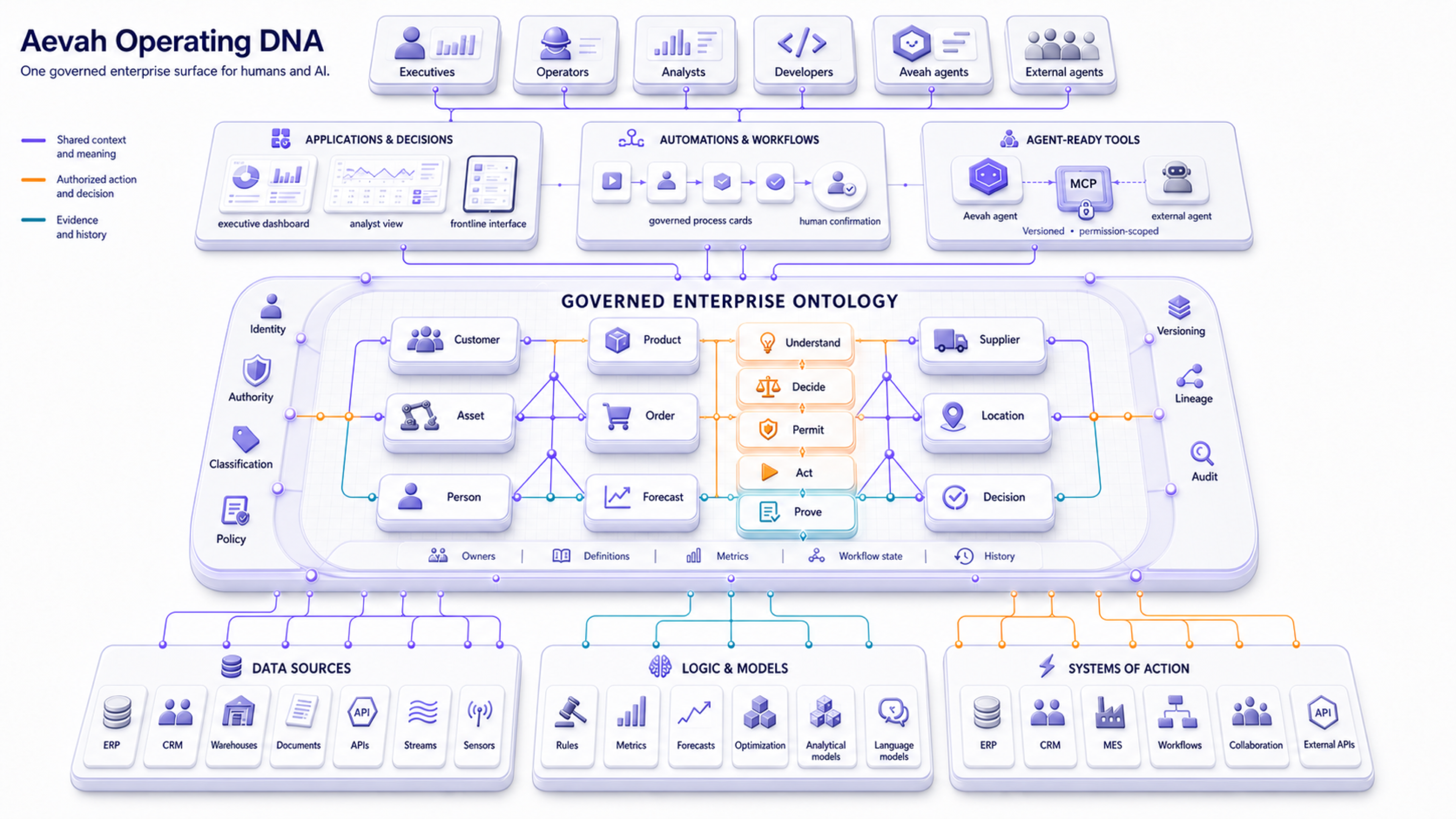
Operating DNA in one view
Aevah turns data, logic, models, and operational systems into living business objects that people, applications, workflows, and agents can understand and use through one governed semantic surface.
The Aevah evaluation path
Every page should answer the buyer’s next question and move the same evaluation forward.
Begin with a measurable business result and the executive accountable for improving it.
Continue →Name the consequence, current burden, baseline, intervention, and measures that matter.
Continue →Trace the data, meaning, models, application, workflow, and learning required in production.
You are hereEvaluate authority, security, deployment, implementation boundaries, and acceptance evidence.
Continue →Leave with a useful outcome and value hypothesis before deciding whether a working session is warranted.
Continue →ERP, CRM, warehouses, documents, APIs, streams, sensors, models, rules, and operational systems connect through governed entities and relationships instead of remaining isolated technical schemas.
A Customer, Product, Supplier, Asset, Person, Location, Order, Forecast, or Decision can carry its identity, definitions, relationships, measures, owner, policy, workflow state, lineage, versions, actions, and evidence.
Executives, operators, analysts, developers, applications, Aevah agents, and authorized external agents work from the same business meaning while receiving only the context and capabilities permitted for their identity and purpose.
Aevah connects understanding to decision, permission, action, and proof. Every consequential change can retain the applicable authority, confirmation, source context, version, activity history, and resulting evidence.
Models, providers, applications, and infrastructure can change while the customer’s business meaning, policy, workflow state, decision history, and evidence remain a durable, portable operating asset.
A practical next step
Create a preliminary Value Brief with the outcome, owner, current burden, value levers, signals, measures, constraints, and bounded starting point—before deciding whether a conversation is worthwhile.
Map one business domain