

On behalf of a person
The agent carries a delegated token bound to that person's session. It never receives their credentials, cannot mint a token, cannot choose which identity it acts as, and ends when their session ends.
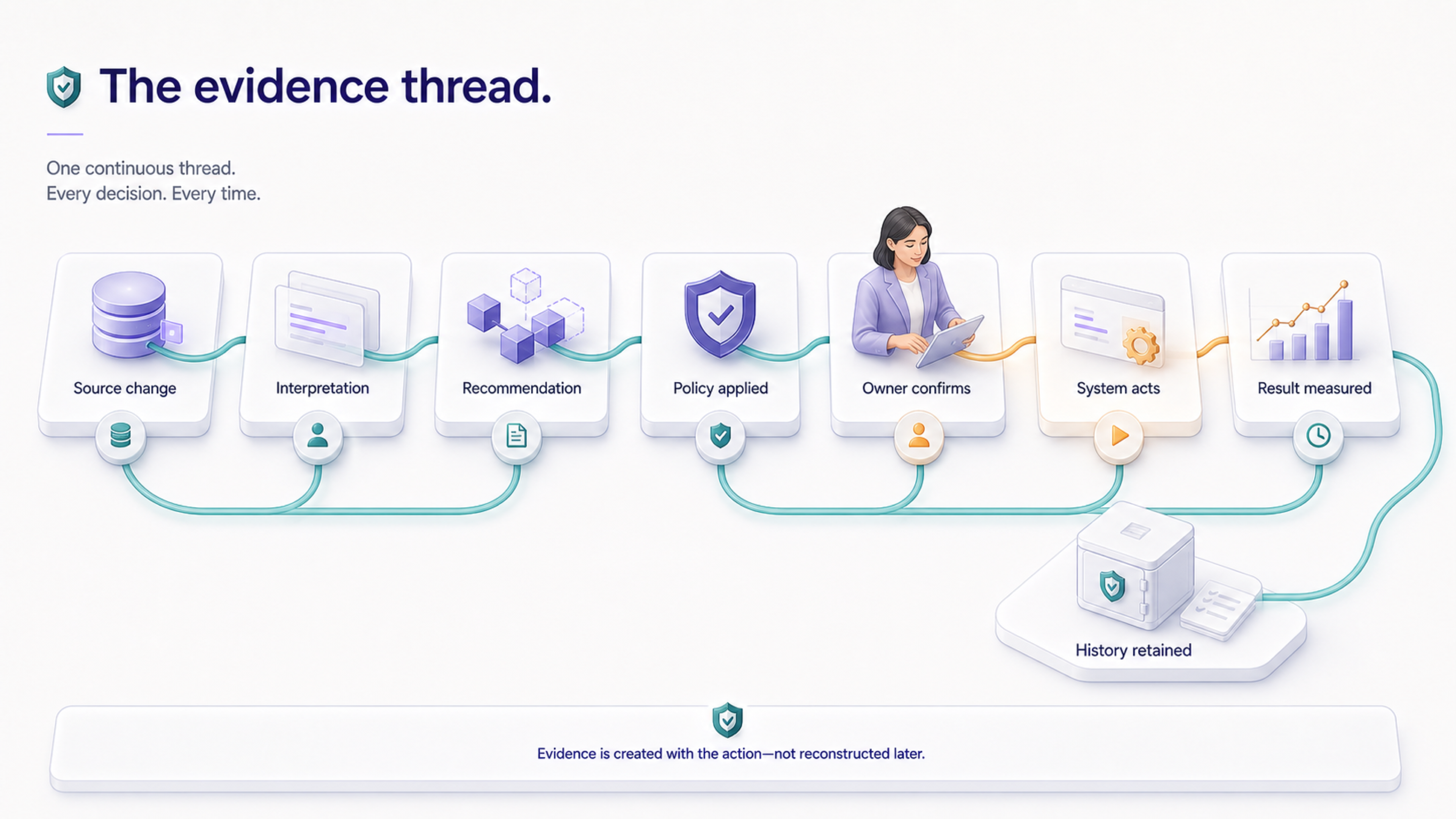
Identity, authorization, permitted data, classification, human confirmation, isolation, recovery, and audit remain connected from recommendation through action.
OutcomeEvery consequential action remains attributable, reviewable, and recoverable
Evidence with the work
A continuous evidence thread carries source, identity, policy, confirmation, action, and result context through the work instead of reconstructing the story afterward.
The Aevah evaluation path
Business relevance, data and model scope, identity, authority, confirmation, evidence, deployment, and recovery remain connected through evaluation and production.
Begin with a measurable business result and the executive accountable for improving it.
Continue →Name the consequence, current burden, baseline, intervention, and measures that matter.
Continue →Trace the data, meaning, models, application, workflow, and learning required in production.
Continue →Evaluate authority, security, deployment, implementation boundaries, and acceptance evidence.
You are hereLeave with a useful outcome and value hypothesis before deciding whether a working session is warranted.
Continue →Identity
Authentication is always delegated to the customer's identity provider — OpenID Connect with Microsoft Entra ID as a first-class provider, SAML federation, and OAuth 2.1 for programmatic and agent access. Aevah is never a place where credentials live.
Authorization context
The agent carries a delegated token bound to that person's session. It never receives their credentials, cannot mint a token, cannot choose which identity it acts as, and ends when their session ends.
A first-class principal governed exactly like a user account: a named human owner, administrator-assigned permissions, its own lifecycle, independent revocation, and its own identity in the audit trail.
There is no third mode, no ambient authority, and no anonymous path to governed data. Permissions are never pooled across a chain — a parent agent can narrow a task, never widen it.
Execution-time authority
Every consequential operation re-resolves the caller's current roles, permissions, record scope, and field authority at the moment it runs. A permission revoked seconds ago is already gone. Revocation at the identity provider cascades immediately, and permissions are enumerated explicitly — never wildcarded.
Data classification
| Tier | Access | Export | Access logging |
|---|---|---|---|
| Public | Unrestricted | Allowed | — |
| Internal | Standard access control | Allowed | — |
| Confidential | Role-gated | Allowed | Every access |
| Restricted | Role-gated | Blocked — cannot leave the platform boundary | Every access |
Classification applies identically to interface, API, and agent calls. Values a caller may not see cannot influence anything they can see — not counts, not facets, not sort order, not derived results.
PII is an independent flag applied alongside classification. External model inference is limited to Public and Internal non-PII content; anything more sensitive fails closed rather than degrading.
Isolation
Every customer runs a discrete instance at its own URL — self-hosted in the customer's own environment, managed by Aevah in a region the customer selects, or sovereign and air-gapped with no external egress. There is no shared data plane between customers.
Cross-customer access isn't denied by a rule that could be misconfigured. The data isn't present to reach.
Vendor access
For Aevah-managed instances, Aevah personnel hold no standing access to customer data. Support access is requested, customer-approved, time-boxed, scoped to the issue, and recorded in the customer's own audit trail.
Audit
Aevah audits sign-in outcomes, authorization denials, delegation issuance and termination, agent lifecycle and permission changes, every access to Confidential and Restricted data, every governed change, approval decisions, and export attempts including blocked ones. Records are immutable — they can be added to, never altered or deleted, including by administrators. Retention is customer-configured and records stay within the customer's own boundary.
Aevah is designed against ISO/IEC 27001, NIST SP 800-53 AC-16, SOC 2 CC6, and PCI-DSS classification requirements. Full control detail is provided during RFP and pilot.
Error contract
An error never reveals the presence or content of a record you may not see.
{ "status": 401, "error": "unauthenticated",
  "message": "No valid identity was presented.",
"correlationId": "3f9c1a7e-..." }{ "status": 403, "error": "forbidden",
"message": "Permission 'connected_system.manage' is required.",
"requiredPermission": "connected_system.manage",
"correlationId": "8b21d4c0-..." }{ "status": 403, "error": "policy_denied",
"message": "Export is not permitted for Restricted content.",
"policy": "classification.export",
"classification": "Restricted",
"correlationId": "c47a09fe-..." }{ "status": 409, "error": "approval_required",
"message": "This change requires steward approval before execution.",
"proposalId": "prop_9d3f21",
"requiredPermission": "steward.approve_merge",
"correlationId": "5e8f3b12-..." }A practical next step
First define the decision scope, deployment boundary, identities, permitted data, actions, controls, responsibilities, and evidence the buying committee needs. We will map the relevant control detail to that evaluation.
Define your evaluation