There is plenty of content about what AI will do.
Transformation. Acceleration. Intelligence at scale.
These descriptions are not wrong. They are abstract in a way that makes them easy to nod at and hard to act on.
This post is different. It describes what specifically changes in a finance function when AI is running on a governed data layer and actually delivering — not in a future state, but in the organizations that got the implementation right.
The changes are operational, relational, and strategic. They are measurable. And they compound.
What most finance functions look like before
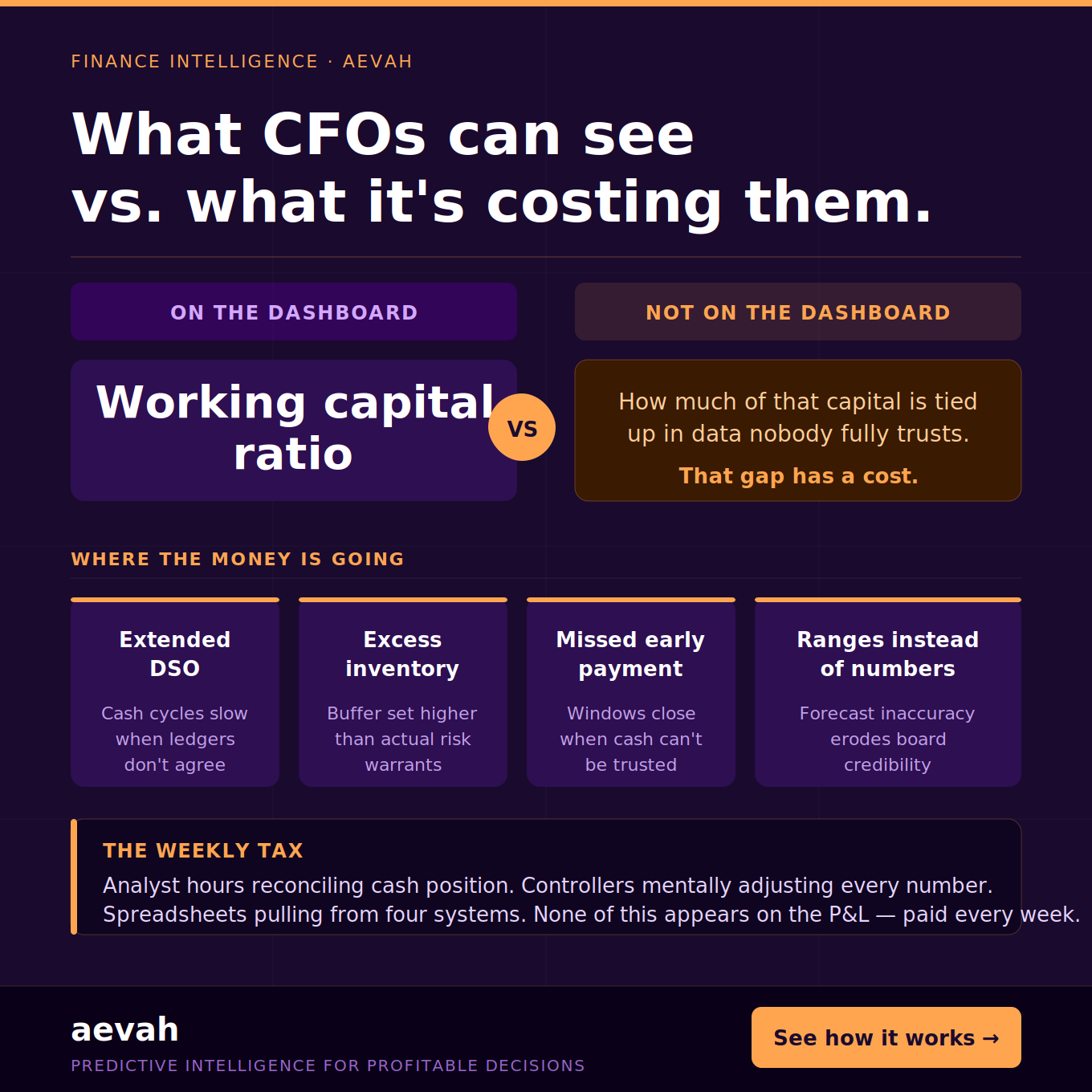
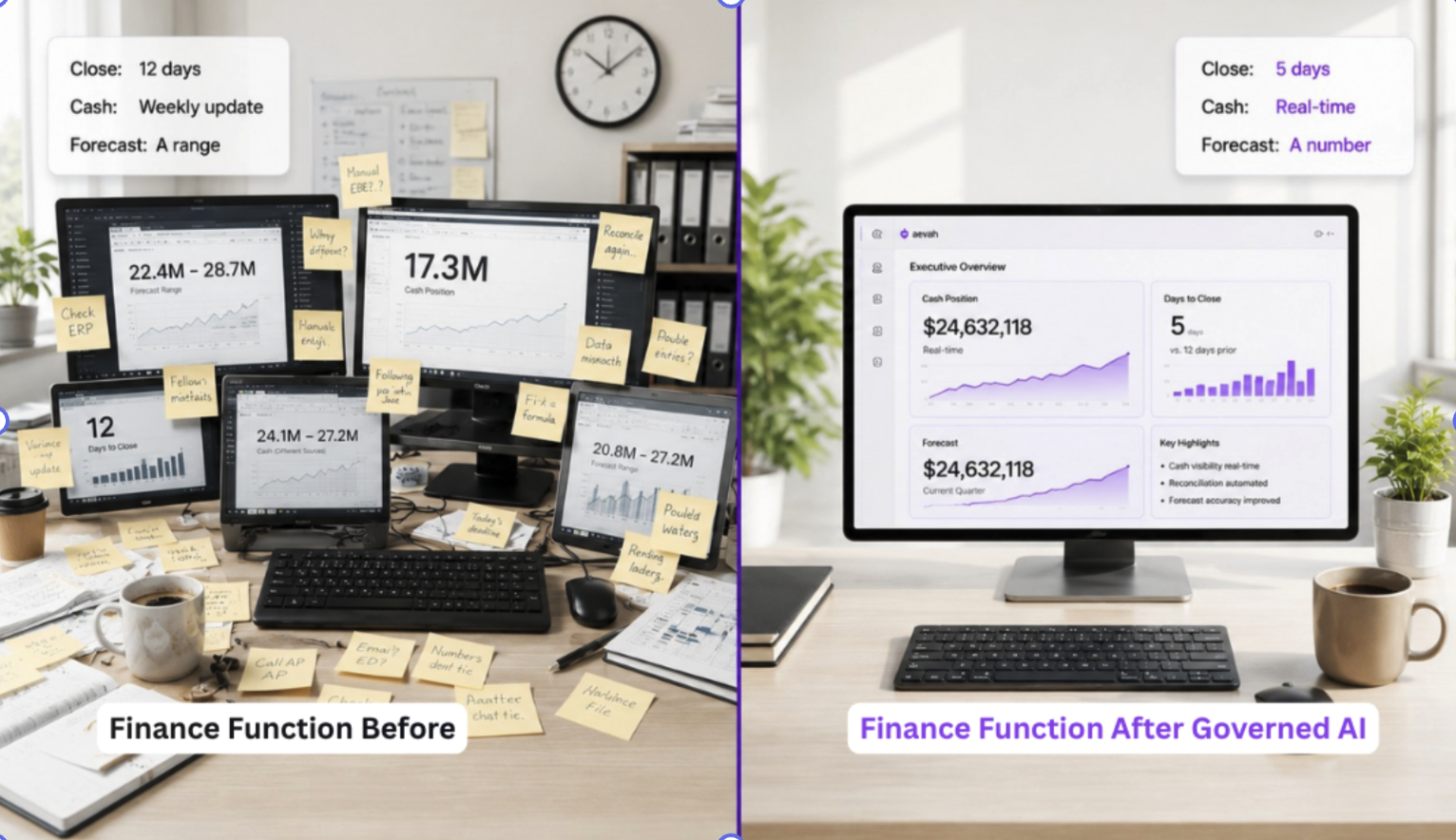
The close cycle runs on a predictable schedule of reconciliation, exception handling, and manual validation. Cash position is known approximately. Forecasting produces a range because the inputs are not clean enough to defend a point estimate. The CFO explains variance to the board after it has occurred — because the data arrives too slowly and with too much uncertainty to support a forward-looking conversation with confidence.
What changes operationally
The close cycle compresses.
When a governance layer resolves conflicts across systems automatically — when ERP, treasury, and operational data agree because consistency is enforced — the manual reconciliation work disappears.
Finance teams closing in 10-12 days move to 5-7. Teams at 7-8 days move to 3-4.
Cash visibility becomes real-time.
When one governed layer connects treasury, ERP, and banking data with automated lineage tracking, the cash position on screen at 9am Monday is the same number in every system, updated with the same cut-off, traceable to the same sources.
Forecasting shifts from range to number.
When forecast inputs are governed and consistent, forecast accuracy improves. The finance function moves from presenting a range with a 10-12% variance to presenting a point estimate with a documented basis.
What changes relationally
The CFO's relationship to the board shifts.
In a governed intelligence environment, the CFO shifts to anticipatory. Leading indicators are visible before they appear in reported results.
The finance team's role changes.
Finance teams stop being data retrieval services and begin doing the analytical work they were hired for.
What changes strategically
Capital decisions get faster and better.
When the CFO has a trusted view of margin by product, customer, channel, and geography, capital allocation decisions carry less uncertainty and can be made at the speed of the opportunity.
The compounding effect
These changes do not operate independently. A faster close produces earlier reporting. Earlier reporting creates more time for analysis. Better analysis improves forecast quality. Better forecasts enable faster capital deployment. Faster deployment improves returns.
Aevah builds the governed intelligence layer that makes this finance function possible — in 90 days, on the infrastructure already in place.
[Share this with a CFO who is still waiting for AI to deliver what was promised.]