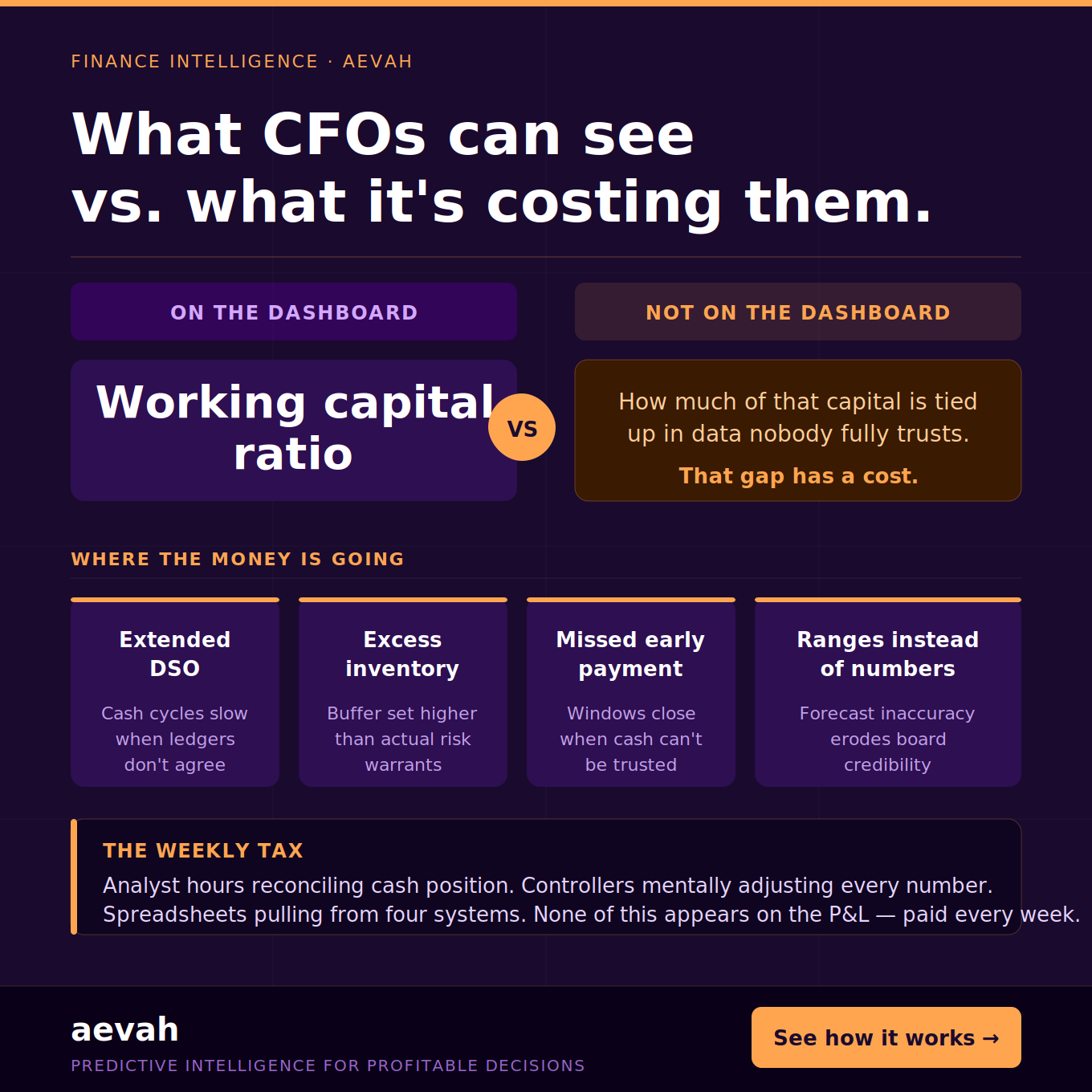
Your working capital ratio is on the dashboard.
What is not on the dashboard is how much of that capital is tied up in decisions made on data nobody fully trusts.
That gap has a cost. It does not show up as a line item. It shows up as slower cash cycles, missed opportunities, and a cash position that is always approximately right — never exactly right.
This is the hidden cost of fragmented data. And for most enterprise finance functions, it is larger than any cost reduction program currently being considered.
Where the money is going
Cash cycles slow down.
When receivables data lives in multiple systems that do not agree, collections teams work from different versions of the same ledger.
A customer flagged as overdue in one system may have already paid in another. A dispute resolved in the CRM may not yet be reflected in the ERP.
The result: slower follow-up, extended DSO, and working capital sitting in the wrong place — not because the cash is not there, but because the picture is never clean enough to act on with confidence.
Inventory carries more buffer than it needs to.
When demand data and supply data do not sync cleanly, the natural response is safety stock.
Buffer gets set higher than the actual risk warrants. Reorder points are conservative. Capital sits in inventory that would not be there if the data were trusted.
Early payment windows close.
Dynamic discounting and early payment programs require one thing: a real-time cash position you trust enough to act on quickly.
When treasury, ERP, and banking data are telling slightly different stories, finance teams hesitate. The window closes. The working capital optimization opportunity passes without a trace on any report.
Forecasting produces ranges, not numbers.
A forecast built on fragmented data carries structural inaccuracy. Teams know it. They compensate with buffer — holding more cash than necessary, delaying capital allocation decisions, presenting ranges to the board instead of numbers.
The cost that never gets named
There is a weekly tax that most enterprise finance functions pay without realizing it.
It is the analyst hours spent reconciling two versions of cash position before the Monday review. The controller who mentally adjusts every reported number because they know the system is slightly off. The team maintaining a master spreadsheet that pulls from four systems and requires manual updates twice a day.
This work does not appear on the P&L. It appears as salary and overhead. But it is the direct cost of not having a governed data layer — paid every single week.
What changes when the data is governed
When one governed layer resolves conflicts across systems and maintains a single source of truth, the effects are immediate and structural.
Cash position becomes a number, not a range. Collections work from one ledger. Inventory decisions carry less buffer. Early payment programs run with confidence. The close cycle shortens because the reconciliation work disappears.
The outcome is not just faster decisions. It is better ones — made on data that can be defended, not approximated.
Aevah gives finance leaders one governed view of cash position and working capital — built on existing systems. Measurable outcomes in 90 days.
[Share this with a finance leader who is working from approximately the right numbers.]