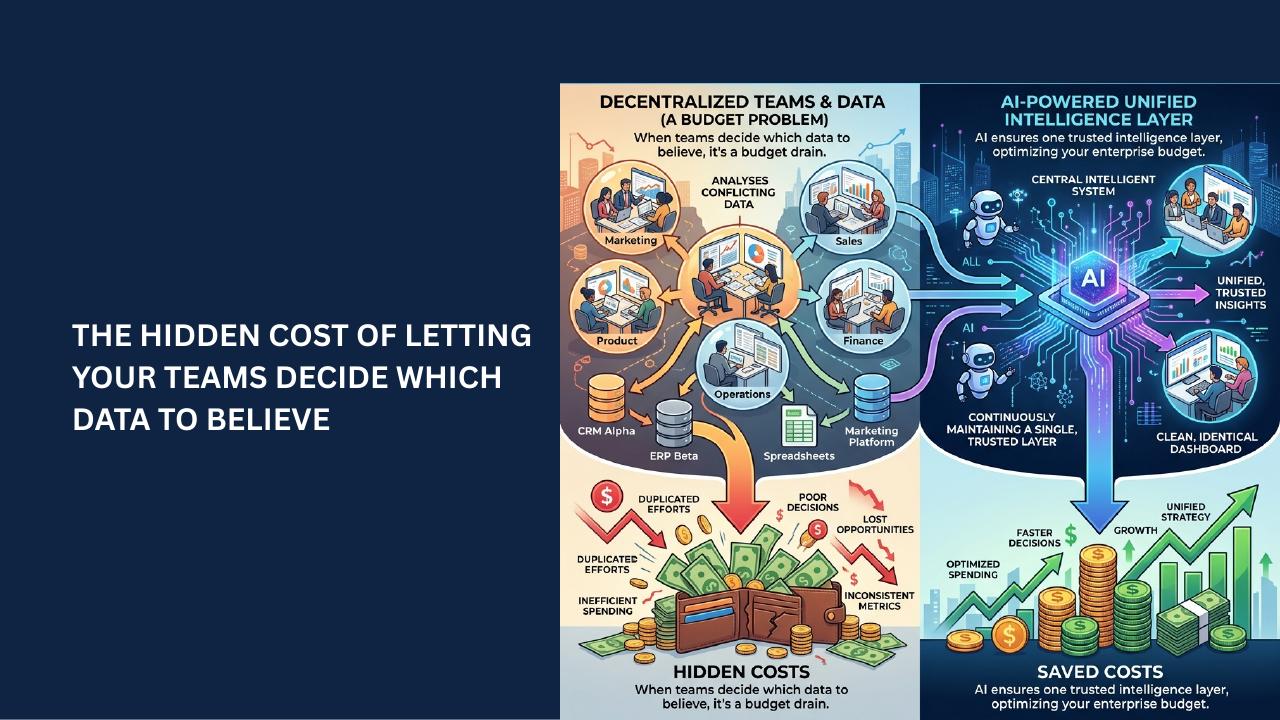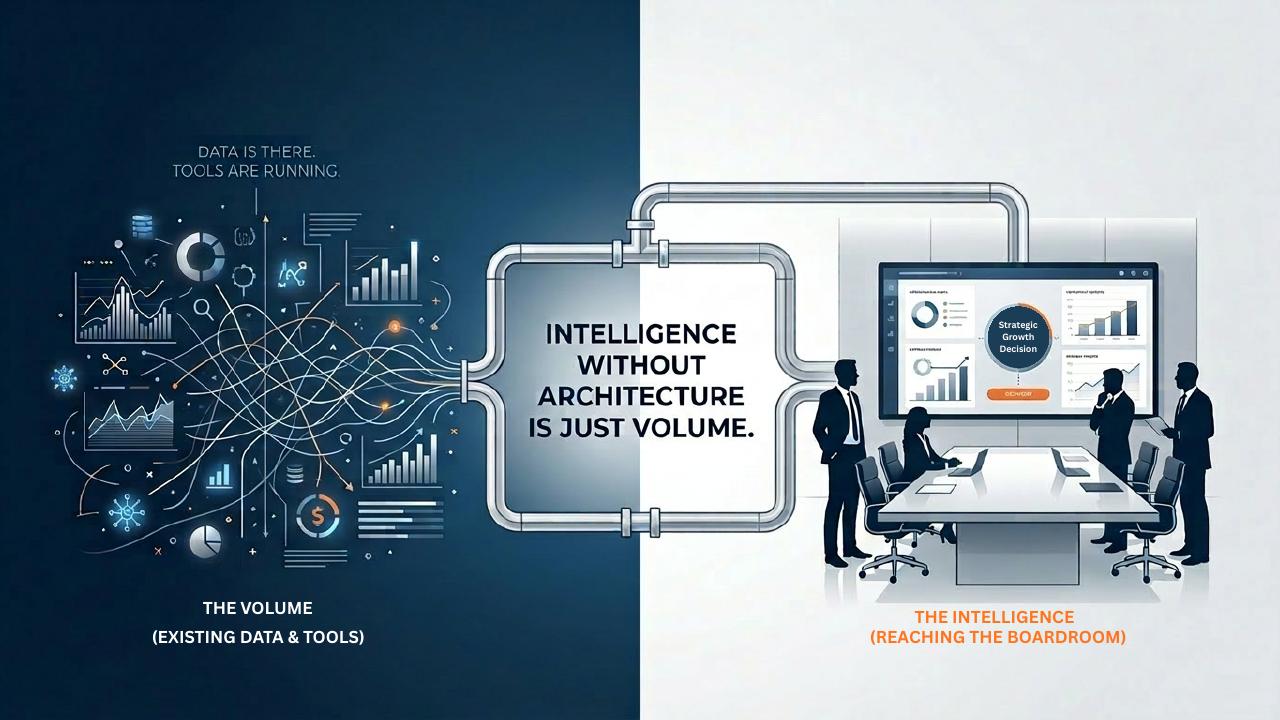
They are generating more data than ever. They have deployed AI tools to make sense of it. And their leadership team is still waiting for the clarity that was supposed to follow.
The data is there. The tools are running. The intelligence is not arriving.
This is not a failure of AI. It is a failure of architecture.
Intelligence Without Architecture Is Just Volume
Enterprises today manage data across dozens — often hundreds — of systems. ERP. CRM. Supply chain platforms. Customer data tools. SaaS applications added function by function over the past decade.
Each of these systems holds valuable information. And in almost every case, that information is defined differently, structured differently, and updated at a different frequency than the system sitting next to it.
The result: your enterprise's most valuable intelligence is distributed across systems that were never designed to communicate with each other — and AI tools that operate on top of that environment produce outputs that reflect the fragmentation below them.
76% of leaders still face fundamental data challenges from legacy infrastructure and siloed datasets, even as they deploy AI. (DDN / Vanson Bourne, 2026)
Your people are not blocking AI. Your systems are.
What "Unified Intelligence" Actually Looks Like
The concept of unified enterprise intelligence is often described in abstract terms. In practice, it has very specific operational characteristics.
Consider what happened at one of the world's largest consumer goods companies. Before AI could perform at scale, the business faced a familiar structural problem: product data, sales data, and supply chain records were held in separate systems across regions — inconsistently defined, inconsistently updated, and inconsistently trusted.
The breakthrough came not from deploying a more capable model, but from first establishing a unified, governed master data foundation. Once product and demand data was harmonized across markets and functions, AI had something reliable to work from. The results that followed were measurable and direct: forecast error reduced by 30%, safety stock cut by 15%, and approximately $300 million saved in annual inventory holding costs. AI-driven forecasting also improved demand prediction by 35% at the factory level, while finished goods inventory fell by 16% — allowing the business to serve consumers faster with less waste. (Unilever / Manufacturing Digital, 2025; AI in the Chain, 2025)
None of those outcomes were possible while the data remained fragmented. The AI capability was available. The foundation was not.
This is the pattern across industries.
Deloitte identifies the same dynamic across high-performing enterprises: the organizations achieving transformative AI results are those where senior leadership actively shapes data governance — treating it as a strategic priority, not a technical function.
The Difference AI Makes in Master Data Management
Traditional MDM built unified records through manual effort. Data stewards reviewed, reconciled, and approved changes. The process was correct in principle but slow in practice — and unable to keep pace with the volume and velocity of modern enterprise data.
AI-driven MDM changes the operating model entirely:
Discovery is automated. AI identifies and catalogs master data entities across thousands of sources — a process that previously required weeks of manual data engineering.
Normalization is continuous. Whether your supplier is listed as "Acme Corp," "Acme Corporation," or "ACME-Corp-US" across three systems, AI resolves the inconsistency in real time, maintaining a single authoritative record.
Governance is proactive. AI detects data quality degradation before it reaches decision-makers — forecasting issues and triggering remediation automatically.
Scale is built in. The MDM market is projected to grow from $18.6 billion in 2025 to $57 billion by 2032, driven by enterprise AI adoption requiring reliable, governed data at an unprecedented scale. (Fortune Business Insights)
When every AI tool your enterprise runs draws from this governed, unified layer, the intelligence your organization has been generating for years finally reaches the people who need to act on it.
From Data Volume to Strategic Clarity
Aevah was built to close the gap between intelligence that exists in your enterprise and intelligence that reaches your boardroom.
The Governed Semantic Layer connects every system, entity-resolves every record, and enforces governance policy across every AI agent and analytics model in your organization. The Analytics Intelligence Engine turns that foundation into real-time KPIs, predictive forecasts, and working capital clarity your CFO, CRO, and operations leaders can act on — in 90 days, without replacing your existing systems.
The forecast built on last quarter's data is already wrong. Governed, real-time intelligence is the competitive position.
Is your enterprise intelligence truly unified, or is fragmented data stalling your AI's strategic potential? Interested to know more about AI as MDM: An Executive Overview — the strategic case for unified enterprise intelligence, built for C-suite decision-makers.