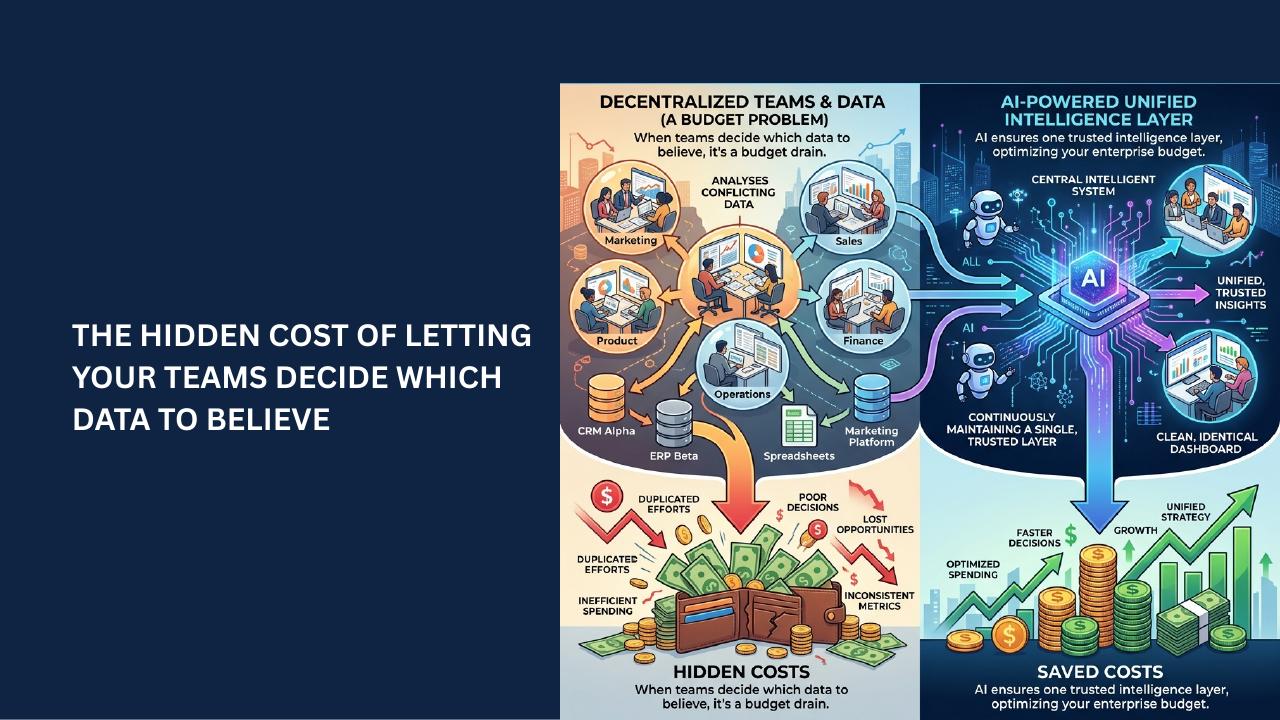
A sales team exports a report from the CRM. A finance team pulls the same metric from ERP. The numbers do not match. Someone schedules a meeting to determine which one to believe.
That meeting, multiplied across every business function, every week, is not a minor inefficiency. It is a leadership problem with financial consequences.
When Data Governance Is Missing, Decisions Fill the Gap
In the absence of a single, authoritative source of truth, teams make individual decisions about which data to trust. Those decisions vary by department, by tenure, by personal preference. And because they are rarely surfaced or documented, they compound invisibly — leading to strategies built on inconsistent foundations, forecasts that cannot be reconciled, and AI outputs that different teams interpret differently.
82% of IT executives say silos between business units and IT stand directly in the way of their organization's ability to execute technology initiatives. (Nutanix Enterprise Cloud Index, 2026)
That figure understates the strategic cost. When business units operate from different versions of the same data, technology is not the only thing that stalls. Decisions stall. Alignment stalls. And in an AI-powered enterprise, where decisions are meant to move faster than ever, the gap between what AI promises and what it delivers becomes a boardroom conversation.
Data Preparation Is Still Consuming the People You Hired to Analyze It
There is a telling number that does not appear in most AI strategy decks.
Data science teams spend roughly 45% of their time on data preparation tasks — cleaning, deduplicating, and reconciling data before they can begin any analysis. (Anaconda State of Data Science Survey)
These are not junior staff running administrative tasks. These are the people organizations hired — and compensated significantly — to surface intelligence that drives strategy.
The IBM Institute for Business Value (2025) found that 43% of chief operations officers now identify data quality as their most significant data priority. More than a quarter of organizations estimate annual losses exceeding $5 million from data quality issues alone.
The cost is sitting in the headcount budget, compounding every pay period.
What AI as MDM Does to This Problem
AI-driven Master Data Management does not ask your data teams to spend less time cleaning data. It removes the conditions that make that work necessary.
Aevah's platform addresses this through three integrated layers: a Governed Semantic Layer that creates one unified, policy-enforced truth across every system; an Analytics Intelligence Engine that gives your CFO, CRO, and operations leaders one confident number instead of five conflicting ones; and Agentic AI Execution that eliminates redundant manual processes built on top of fragmented data.
The downstream effect is significant: data teams spend their capacity on analysis, not preparation. AI tools draw from validated, unified data. Leadership receives intelligence every function is working from simultaneously.
40% faster cash cycles and 3–5% margin recovery are the documented outcomes when this foundation is in place — not at the end of an 18-month program, but within 90 days.
The Strategic Decision for Enterprise Leaders
The question most C-suite conversations center on is: what AI tools should we deploy?
The more consequential question is: what are those tools drawing from?
AI as MDM answers the second question — and in doing so, dramatically improves the answer to the first.
Is your data holding back your AI strategy, or is it ready to power it? Explore with us the Executive Guide to AI-Ready Data — a framework for evaluating and closing your data foundation gap.
